

Is your influencer marketing budget at risk? Fake followers can drain your campaign ROI, with businesses losing $1.3 billion yearly to influencer fraud. This article compares free and paid fake follower detection tools to help you decide which option fits your needs.
Key Takeaways:
- Free Tools: Good for quick checks with basic features like engagement rates and follower growth graphs. Accuracy hovers around 60–70%.
- Paid Tools: Offer deeper insights, AI-powered detection, and 85–95% accuracy. Prices range from $49 to $299/month, ideal for high-budget campaigns.
Quick Comparison:
| Feature | Free Tools | Paid Tools |
|---|---|---|
| Cost | $0 | $49–$299/month |
| Accuracy | 60–70% | 85–95% |
| Follower Analysis | Limited sample | Full audience analysis |
| Advanced Features | None | AI-driven fraud detection, NLP |
Free tools are great for startups or small campaigns (<$5,000). For budgets above $10,000, paid tools provide better protection and reporting. Start with free tools for initial screenings, then use paid tools for high-value influencers.
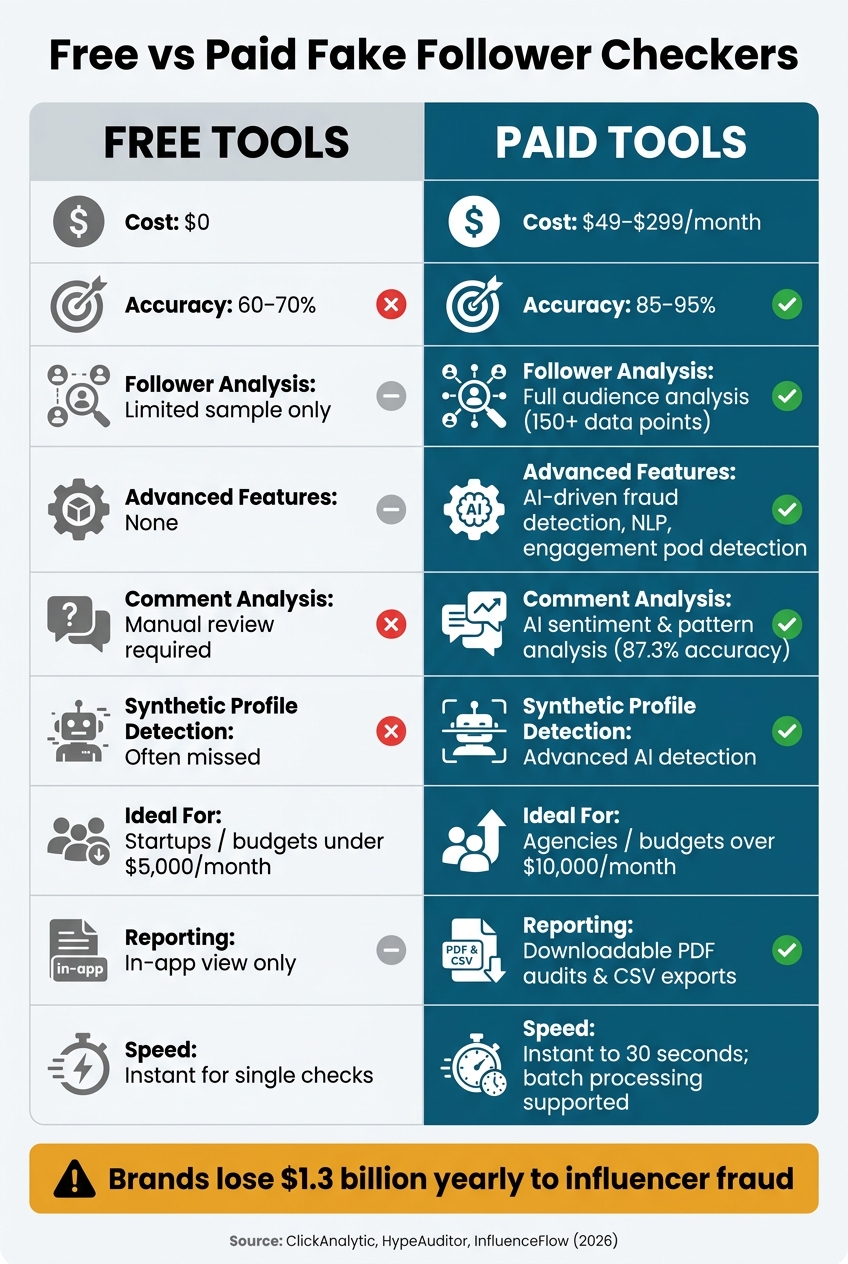
Free vs Paid Fake Follower Checkers: Key Differences at a Glance
Free Fake Follower Checkers: What You Get and What You Miss
What Free Tools Include
Free fake follower checkers offer a basic way to assess the authenticity of social media accounts. Typically, they provide an Audience Quality Score (on a scale from 1 to 100), an engagement rate benchmarked against platform standards, and a follower growth graph that highlights any unusual spikes. For example, DoSponsor doesn’t require a signup, and ClickAnalytic allows unlimited checks for individual accounts.
These tools also flag red flags like high ratios of ghost followers, mass-following behaviors, and generic bot-like comments. Some go a step further by breaking down an audience’s demographics, such as top countries or cities, to help verify whether a creator’s followers match their stated niche. For context, Instagram engagement rates generally range between 1.5% and 6%, and a like-to-comment ratio exceeding 100:1 might suggest artificial activity. While these metrics offer a helpful starting point, they only scratch the surface, as the next section explains.
Where Free Tools Fall Short
Free tools typically analyze only a small sample of followers, which limits their accuracy. On average, these tools are around 60–70% accurate, compared to the 85–95% accuracy offered by paid options.
"A percentage is a signal, not a verdict. Useful for triage. Useless if you treat it like proof of fraud." – ClickAnalytic
Another challenge lies in evaluating accounts with 15–30% fake followers. In these cases, even slight differences in methodology can determine whether an account passes or fails. Free tools also struggle to identify more advanced threats, like AI-generated synthetic profiles, which have risen by 91% year-over-year as of 2026. Similarly, purchased accounts that are technically real but inactive often slip through undetected.
Most free tools only evaluate the last 30–60 posts, meaning creators who recently improved their follower quality might appear authentic despite past issues. Advanced features like comment sentiment analysis, growth velocity tracking, and access to historical fraud data are usually reserved for paid versions.
In short, while free tools are great for quickly screening creators and spotting obvious issues, their findings shouldn’t be treated as definitive proof. For deeper insights, especially in complex situations, investing in paid tools may be necessary.
sbb-itb-2ec70df
Paid Fake Follower Checkers: Deeper Detection and Better Data
What Paid Tools Include
Paid tools bring serious muscle to the table, analyzing over 150 data points per account with machine learning models trained on millions of profiles. This approach delivers highly reliable insights that free tools just can’t match. Features like engagement pod detection – which identifies groups of 20–200 accounts that interact with posts almost instantly – help spot coordinated manipulation. Network mapping uncovers clusters of followers tied to bot farms, while Natural Language Processing (NLP) differentiates authentic human comments from cookie-cutter bot replies.
These platforms also offer real-time monitoring with automated alerts to flag suspicious activity during campaigns. Tools such as HypeAuditor (starting at $49/month) and Sprout Social (ranging from $249 to $499/month) come with extras like downloadable PDF reports, batch CSV uploads, and saved audit histories. These features are particularly helpful for teams managing multiple creators, making paid tools a far more practical and reliable choice than free options.
Why Paid Tools Are More Accurate
Free tools typically hit an accuracy ceiling of 60–70%, whereas paid tools reach a much higher 92–95% accuracy rate. AI detection capabilities are also improving dramatically, jumping from 78% in 2024 to an impressive 94% by 2026. This level of precision is essential for campaigns where budgets exceed $5,000. Spending $15–$50 on a single paid report can act as an insurance policy, protecting your investment from being wasted on a fraudulent audience. Considering that brands lose an average of $5,000 per fake influencer partnership and nearly 49% of brands have been burned by unverified creators, the cost of a paid tool often justifies itself.
Paid tools also excel at catching the most sophisticated fraud, like AI-generated synthetic profiles and purchased accounts that mimic real users. As of 2026, AI-driven fake engagement is 40% harder to detect than it was just two years earlier. Free tools simply aren’t designed to tackle this level of complexity, making paid options the smarter choice for deeper and more reliable detection.
Free vs Paid Fake Follower Checkers: A Direct Comparison
Detection Methods and Signals
The biggest distinction between free and paid fake follower checkers lies in how thoroughly they analyze data. Free tools rely on public metrics, offering basic engagement ratios and highlighting obvious spikes in follower growth. On the other hand, paid tools dig much deeper, using AI to analyze comment sentiment, map follower connections, and detect synthetic profiles that often slip past surface-level checks.
For example, free tools require manual effort to identify suspicious, bot-like comments. Paid tools, however, employ Natural Language Processing (NLP) models to scan thousands of comments automatically, flagging repetitive patterns with an impressive 87.3% accuracy in identifying fraudulent activity.
| Signal | Free Tools | Paid Tools |
|---|---|---|
| Engagement-to-Follower Ratio | Basic calculation based on recent posts | Benchmarked against averages for specific niches and platforms |
| Follower Spike Detection | Flags recent growth spikes | Provides detailed historical growth charts |
| Profile Authenticity | Requires manual checks of bios/photos | Uses AI to scan thousands of profiles for anomalies |
| Comment Analysis | Manual review required | AI-driven sentiment and pattern analysis (87.3% accuracy) |
| Audience Demographics | Limited or hidden data | Detailed breakdowns by location, age, gender, and language |
| Synthetic Profile Detection | Often overlooked | Advanced AI detection for synthetic profiles |
These differences highlight the trade-offs between simplicity and depth, helping users decide based on their specific needs.
Cost vs Accuracy: Key Trade-offs
When it comes to balancing cost with accuracy, the gap between free and paid tools becomes even more apparent. Paid tools offer significantly higher accuracy, which can directly impact campaign outcomes. For brands and agencies, this accuracy often justifies the expense.
"Verification ROI averages 300–400%. Avoiding one fake $50,000 campaign pays for verification tools for 2 years." – InfluenceFlow
| Criteria | Free Tools | Paid Tools |
|---|---|---|
| Cost | $0 | $59 – $1,500+/month |
| Accuracy | 60–70% | 85–95% |
| Speed | Instant for single checks | Instant to 30 seconds; supports batch processing |
| Data Depth | Basic public metrics | Includes historical data, private API insights, and advanced demographics |
| Reporting | In-app view only | Downloadable PDF audits and CSV exports |
| Ideal For | Individual creators for quick checks | Agencies and brands managing large-scale campaigns |
For campaigns exceeding $5,000, the robust reporting features of paid tools – such as shareable audits – can be a game-changer, offering reliable proof of authenticity and helping to safeguard investments.
How To Check Instagram Fake Followers in 30 Seconds
How to Choose the Right Tool for Your Needs
Selecting the right tool depends on factors like your influencer budget, the number of creators you evaluate, and how much risk you can afford. Here’s a breakdown of when free tools are enough and when it’s worth investing in paid options.
When Free Tools Are Enough
Free tools are a great option if you’re just starting out or working with a tight budget. They can help you narrow down a list of potential creators without spending a dime. This approach works especially well for:
- Startups or small businesses spending less than $5,000 per month on influencers.
- Brands reviewing fewer than 50 influencers monthly.
In these cases, pairing free tools with some manual checks can get the job done. That said, as your budget and the number of influencers you evaluate grow, free tools can start to show their limitations.
When Paid Tools Make Sense
Once your monthly influencer spend exceeds $10,000, the risk of fraud jumps by 20–30%. At this level, a paid tool – typically costing between $99 and $299 per month – becomes a smart investment to protect your budget.
Paid tools also shine when you need solid documentation for audits. As Luke Bae from Syncly explains:
"The main reason to pay for verification is defensibility. Tools help a marketer explain the ‘why’ behind a no-go decision in a way that legal, procurement, finance, or an agency client can accept."
For partnerships that span multiple markets or last for an extended period, it’s wise to re-audit influencer accounts every 30–60 days. This helps you catch issues like account hacking, sudden follower spikes, or profile sales, ensuring your collaborations remain trustworthy. Regular checks can save you from potential headaches down the line.
Conclusion: Picking the Tool That Fits Your Goals
Choosing the right fake follower checker depends on how much risk you’re willing to take. With influencer fraud costing brands significant amounts per fake partnership, selecting the wrong tool could lead to real financial losses.
Here’s a helpful rule of thumb: free tools, with around 70% accuracy, are good for catching obvious issues during initial screenings. On the other hand, paid tools – costing between $49 and $299 per month and offering 85%–92% accuracy – are better suited for identifying more sophisticated bot networks, especially when dealing with higher-budget campaigns.
Using these accuracy levels, you can adopt a tiered vetting system to manage costs effectively. Start by screening your entire pool of candidates with free tools, and then use paid tools to analyze a smaller, high-value shortlist. This method ensures a balance between thoroughness and budget efficiency.
To further protect your investment, include a contractual clause requiring influencers to maintain at least 85% real followers. This gives you the right to renegotiate or request refunds if fraud is discovered. As highlighted by the Lessie Team, inflated follower counts can result in overpaying for the same real reach you could achieve with a smaller, genuine audience. Combining technical verification with contractual safeguards creates a solid defense against fraud.
Ultimately, the goal is to reduce risk early on while protecting your budget, reputation, and time. Make sure the tool you choose matches the scale of your campaign and the level of risk you’re managing.
FAQs
What fake-follower percentage is considered too high for a partnership?
When it comes to engagement rates, there’s no one-size-fits-all benchmark. However, rates above 25%-30% are often considered risky. For nano and micro creators, an engagement rate between 10%-15% is generally acceptable. Meanwhile, macro and mega creators can typically handle rates up to 25%.
Instead of fixating solely on percentages, Growth-onomics suggests focusing on accounts that show healthy engagement rates – anything above 0.5% – paired with steady growth trends. This approach helps to spot and steer clear of potential red flags.
How can I manually confirm red flags that a tool reports?
To spot potential red flags, start by sampling 20–30 followers. Look for signs like missing profile photos, bios that don’t make sense, a lack of recent posts, or follower-to-following ratios that seem off. Next, calculate engagement by comparing the number of recent interactions (likes, comments, etc.) to the total follower count. Pay close attention to comments – generic or irrelevant ones can indicate issues. Lastly, review the account’s growth history. Sudden, unexplained spikes in followers, especially when not tied to campaigns or viral content, can be a warning sign.
How often should I re-audit an influencer during an ongoing campaign?
Auditing influencers is crucial at three main points: before reaching out, before signing a contract, and just before making the final payment. These pre-campaign checks help safeguard your budget and ensure you’re working with the right partner. During the campaign, using real-time monitoring tools can help you spot any suspicious activity as it happens. If real-time tools aren’t available, make it a point to conduct regular audits to ensure the influencer continues to meet your quality standards throughout the project.