


Social media attribution helps you understand which social interactions – like clicks, shares, or messages – contribute to conversions. With 70% of marketers finding it hard to prove ROI, attribution models offer a way to track customer journeys and allocate budgets effectively.
Here’s what you need to know:
- Single-Touch Models: First-Touch and Last-Touch assign all credit to one interaction but miss the bigger picture.
- Multi-Touch Models: Linear, Time-Decay, and Position-Based spread credit across multiple touchpoints, offering a broader view.
- Data-Driven Models: Use machine learning to assign credit based on actual performance but require large datasets.
For example, a fashion brand increased revenue by 28% after identifying Instagram’s role in early customer engagement. Choosing the right model depends on your sales cycle and conversion volume. Start simple and scale to advanced models as your data grows.
7 types of marketing attribution explained (and how to choose the right one)
sbb-itb-2ec70df
6 Main Social Media Attribution Models
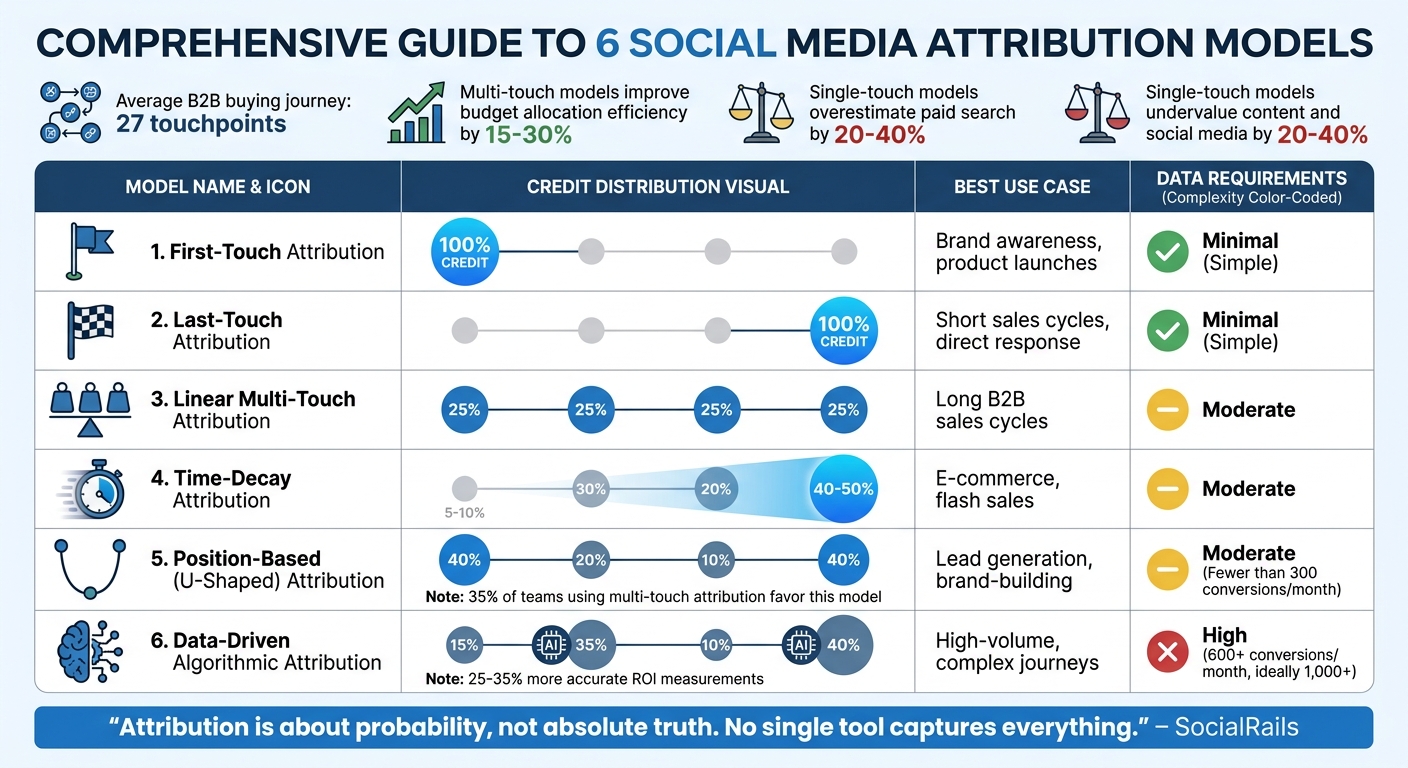
Social Media Attribution Models Comparison: Credit Distribution and Best Use Cases
Choosing an attribution model helps distribute credit across social media interactions. Each model uses a unique method for assigning credit, so picking the right one depends on your business objectives, sales cycle, and the number of conversions you handle.
Single-touch models like First-Touch and Last-Touch are straightforward but may overlook important interactions along the customer journey. In contrast, multi-touch models such as Linear, Time-Decay, and Position-Based provide a broader view by spreading credit across multiple touchpoints. Data-driven models take it a step further, using machine learning to analyze and assign credit based on performance patterns, though they require a significant amount of data to work effectively.
Here’s an interesting fact: the average B2B buying journey now involves about 27 touchpoints before a purchase decision. Companies using multi-touch attribution models often allocate their budgets 15–30% more efficiently than those relying on single-touch models. For instance, marketers who transitioned from single-touch to multi-touch attribution discovered they were overestimating paid search by 20–40% while undervaluing content and social media by similar amounts.
Below is a breakdown of each model, its credit strategy, and when it works best.
First-Touch Attribution
First-Touch Attribution assigns all credit to the very first interaction a customer has with your brand. For example, if someone discovers your business through an Instagram ad, that ad gets full credit for the eventual conversion – even if they interact with other channels later. This model is ideal for evaluating brand awareness efforts and top-of-funnel campaigns.
Last-Touch Attribution
This model gives 100% of the credit to the final interaction before a conversion. If a customer clicks on a LinkedIn ad just before making a purchase, that ad gets all the credit, regardless of earlier touchpoints. It’s commonly used in analytics tools and is particularly useful for businesses with short sales cycles or those focused on immediate conversions.
Linear Multi-Touch Attribution
Linear Attribution spreads credit equally across all touchpoints in the customer journey. For instance, if a prospect engages with your brand through an Instagram Story, a Facebook post, an email, and a retargeting ad, each channel gets 25% of the credit. This model works well for businesses with longer sales cycles, such as B2B companies or services that require multiple interactions before a purchase.
Time-Decay Attribution
Time-Decay Attribution gives more weight to interactions that happen closer to the conversion. For example, touchpoints within a day of the sale might get 40–50% of the credit, while earlier interactions receive less. This approach is great for e-commerce businesses with short decision cycles, flash sales, or time-sensitive promotions.
Position-Based (U-Shaped) Attribution
Also known as the U-Shaped model, this method allocates 40% of the credit to the first touchpoint, 40% to the last, and divides the remaining 20% among the middle interactions. It’s a popular choice – about 35% of teams using multi-touch attribution favor this model. It’s especially effective for lead generation and industries where both initial engagement and final conversion are critical. This model is also practical for businesses with fewer than 300 conversions per month.
Data-Driven Algorithmic Attribution
Data-Driven Attribution uses machine learning to assign credit based on each interaction’s actual impact. Advanced techniques, like Shapley values from game theory, can even measure a channel’s marginal contribution. Brands with substantial datasets (typically over 1,000 conversions per month) benefit the most from this model, as it provides 25–35% more accurate ROI measurements compared to traditional methods. For example, Google Analytics 4 requires about 600 monthly conversions per action to ensure reliable data, with experts recommending at least 12,000 clicks and 400 conversions monthly for statistical confidence.
"Attribution is about probability, not absolute truth. No single tool captures everything." – SocialRails
| Model | Credit Distribution | Best For | Data Requirements |
|---|---|---|---|
| First-Touch | 100% to first interaction | Brand awareness, product launches | Minimal |
| Last-Touch | 100% to last interaction | Short sales cycles, direct response | Minimal |
| Linear | Equal across all touchpoints | Long B2B sales cycles | Moderate |
| Time-Decay | More to recent interactions | E-commerce, flash sales | Moderate |
| Position-Based | 40% First / 40% Last / 20% Mid | Lead generation, brand-building | Moderate |
| Data-Driven | ML-based, varies by impact | High-volume, complex journeys | High (600+ conv/mo) |
Attribution Model Comparison Table
Each attribution model has its own strengths, ideal applications, and trade-offs. While single-touch models are straightforward, multi-touch and data-driven models better capture the complexities of today’s customer journeys. For example, data-driven models use machine learning to analyze real behavior patterns, offering unmatched precision. However, they require a substantial amount of data – typically over 1,000 conversions per month – and technical expertise to implement effectively. The table below provides a quick breakdown of how each model supports social media attribution efforts, helping you choose the one that aligns with your goals.
A critical takeaway: 68% of marketers struggle to accurately attribute revenue across channels as of 2026. Often, this challenge stems from using models that don’t align with their sales cycle or business objectives.
| Attribution Model | Credit | Best Use Case | Advantages | Disadvantages |
|---|---|---|---|---|
| First-Touch | 100% to first interaction | Brand awareness; new market entry | Highlights discovery sources | Ignores all nurturing and conversion steps |
| Last-Touch | 100% to final interaction | Short sales cycles; bottom-funnel | Easy to implement and track | Overlooks awareness and consideration stages |
| Linear | Equal split across all | Content-heavy strategies | Values the entire journey | Treats all touchpoints equally, regardless of impact |
| Time-Decay | More credit to recent touches | Flash sales; short decision cycles | Reflects recency bias in purchases | May undervalue early brand-building efforts |
| Position-Based | 40% First / 40% Last / 20% Mid | Lead generation; balanced funnels | Accounts for both discovery and conversion | Weighting may not suit all journeys |
| Data-Driven | Algorithm-based | High-volume, complex journeys | Highly precise; adapts to actual data | Requires significant data volume and technical know-how |
How to Implement Social Media Attribution
You can establish social media attribution in 90 days by following a structured process that starts with auditing your data and ends with actionable insights.
Assess Your Current Tracking Setup
Before deciding on an attribution model, you need to understand the data you’re collecting. Start by auditing your tracking setup. Make sure that over 95% of social clicks are being captured, verify that all platform pixels (Meta, LinkedIn, TikTok, Twitter/X) are correctly installed, and identify any missing or improperly formatted UTM parameters. Did you know that 27% of marketing touchpoints have broken or incomplete UTM tags? That means more than a quarter of your attribution data could be inaccurate without any obvious signs.
Check for gaps in your tracking. Are Instagram Story swipe-ups tracked differently than feed posts? Are influencer campaigns using consistent naming conventions? Is your CRM, like Salesforce or HubSpot, integrated with your analytics platform so you can track which social interactions lead to closed deals? Spend one to two weeks on this audit, documenting your findings in a shared spreadsheet. Once you’ve identified the gaps, you’ll be ready to define clear attribution goals.
Set Clear Attribution Goals
After understanding your data collection, set specific and measurable attribution goals. Avoid vague objectives like "better understand social media." Instead, aim for targets such as achieving a ROAS of 3:1 or higher (the 2026 benchmark for paid social), reducing cost-per-acquisition by 15%, or pinpointing which platforms deliver the highest customer lifetime value. Tailor your goals to your business model. For instance, e-commerce brands might focus on immediate conversions, while B2B companies need to monitor assisted conversions, which can account for 30–60% of social’s real revenue impact.
Organize touchpoints by value to align with a multi-touch approach. For example:
- High-value interactions: Demo requests, pricing page visits.
- Medium-value interactions: Blog reads, email sign-ups.
- Low-value interactions: Homepage visits, email opens.
This structure helps eliminate unnecessary noise in your reports and highlights the activities that drive revenue.
Create UTM Naming Conventions
Inconsistent UTM tags can throw off your attribution data. To avoid this, establish clear naming conventions. Use lowercase letters, replace spaces with hyphens, and maintain a master list of approved terms for source, medium, campaign, content, and term.
Simplify this process by creating a UTM builder – a spreadsheet with dropdown options or a tool like UTM.io can work well. Assign one person as the UTM owner to manage the taxonomy and perform monthly audits. For example, consistently tag a TikTok organic post as: utm_source=tiktok&utm_medium=social-organic&utm_campaign=spring-sale-2026.
"If 20% of your campaign links are mistagged, 20% of your attribution data is wrong – and you will never see an error message." – KISSmetrics Editorial
Choose and Configure Tracking Tools
Start with Google Analytics 4 (GA4), which is free, supports multi-touch reporting, and tracks users across devices when Google Signals is enabled. After setting up GA4, add platform-specific pixels like the Meta Pixel with Conversions API, LinkedIn Insight Tag, and TikTok Pixel to capture additional data. For e-commerce brands, tools like Triple Whale ($129–$899/month) offer focused dashboards for Meta and TikTok, while B2B companies often rely on HubSpot ($800+/month) to link social touchpoints to CRM data and revenue.
Adjust your attribution windows to fit your sales cycle. For example:
- Use 7-day click windows for fast-moving e-commerce.
- Opt for 28- or 90-day windows for B2B to capture early-funnel activities.
To maintain accuracy despite iOS 14.5+ privacy changes and third-party cookie restrictions, enable server-side tagging through Conversions APIs. If you’re processing fewer than 300 conversions monthly, start with a Position-Based or Linear model. Upgrade to a Data-Driven model only after you exceed 1,000 conversions per month.
Review Data and Adjust Campaigns
Once your tracking tools are in place, regularly review your data to refine strategies and improve campaign performance. During the initial phase, analyze your data weekly, then shift to monthly reviews as things stabilize. Look for trends. For instance:
- Which platforms show up most frequently in multi-touch journeys?
- Are videos performing better than static images?
- Does LinkedIn drive early B2B engagement while email closes deals?
Use these insights to shift your budget toward high-performing channels and pause underperformers. If more than 10% of your touchpoints lack UTM tags, address this issue before making major budget changes. You can also add a "How did you hear about us?" field to sign-up forms to capture referrals from "dark social" sources like DMs, private groups, and word-of-mouth, which traditional tracking might miss. The aim here isn’t perfect precision but smarter resource allocation.
Advanced Attribution Strategies for 2026
With privacy restrictions tightening, trackable signals have dropped to just 30%–60% of 2021 levels. This shift has led 75% of companies to adopt multi-touch attribution models. To bridge the data gaps, leading teams are combining machine learning, cross-device tracking, and lifetime value (LTV) calculations.
Using Machine Learning for Attribution
Machine learning (ML) can analyze thousands of customer journeys, distributing credit more accurately with methods like Shapley values instead of outdated last-click rules. For example, Google Ads requires at least 300 conversions and 3,000 ad interactions in a 30-day window to generate reliable data-driven attribution. If your data falls short, position-based or time-decay models are better alternatives.
ML also helps address data loss caused by iOS 14.5+ restrictions and cookie limitations by using modeled conversions to estimate missing signals. However, platform-reported conversions from tools like Meta or Google often overestimate actual revenue – sometimes by 2 to 3 times. Cross-checking these figures against your CRM ensures a more accurate picture. Additionally, first-party identity resolution can improve identification rates by 2–5 times, delivering better data for ML models.
"Data-driven attribution distributes incomplete information more elegantly. It does not make incomplete information more complete." – House of MarTech
A growing trend is Agentic AI, where AI agents not only analyze attribution data but also autonomously reallocate budgets based on insights. To enable this, server-side tagging through Conversions APIs can bypass browser restrictions and improve data quality. It’s also crucial to validate ML-driven recommendations. For example, run holdout tests by pausing a specific social channel for part of your audience to measure its true incremental lift.
Next, let’s dive into strategies for tracking customers across multiple devices and sessions.
Tracking Across Devices and Sessions
Modern customer journeys typically involve 3 to 7 touchpoints before a conversion, often spanning multiple devices and sessions. Safari’s 1-day cookie expiration makes returning visitors appear as new users, and opt-in rates for cross-app tracking on iOS hover below 25%. To reconnect fragmented sessions, use both deterministic and probabilistic matching techniques.
Take advantage of tools like Google Signals in GA4 or Meta’s cross-device reporting, which use logged-in user data to track activity within their ecosystems. Encouraging users to create accounts early in their journey – perhaps with incentives – captures deterministic data, which is 100% accurate and greatly improves cross-device conversion tracking.
Another challenge is that 60% of Google searches are now "zero-click", where users find answers without visiting your site. To track these harder-to-capture interactions, add a "How did you hear about us?" field to sign-up forms and feed those insights into your ML models. Unique promo codes for influencers or offline campaigns can also help track conversions that might otherwise go unnoticed.
With tracking in place, the next step focuses on quantifying the long-term value of social media.
Calculating Customer Lifetime Value from Social Media
Social media’s influence often extends beyond immediate conversions, playing a key role in nurturing long-term customer value. In fact, assisted conversions can represent 30% to 60% of social media’s true revenue contribution. To measure this, connect social touchpoints to CRM data, like HubSpot or Salesforce, to track both first-touch and multi-touch sources for closed deals and repeat purchases.
To better evaluate return on investment, calculate Adjusted ROI with this formula:
(Attributed Revenue × Average LTV Multiplier – Spend) / Spend.
For example, if your average customer makes three purchases over their lifetime, apply a 3x multiplier to attributed revenue. Running 90-day cohort analyses can also provide insights. Track all customers acquired in a specific quarter, map their social interactions, and calculate their lifetime value. Segment these results by acquisition source – organic social customers often show higher retention rates, while influencer-referred customers may deliver higher initial quality.
"Advanced attribution modeling transforms social media from a perceived cost center to a measurable profit driver by revealing its true contribution across the entire customer journey." – Hashmeta
Conclusion
Choosing the right attribution model hinges on your conversion volume and the length of your sales cycle. For businesses with fewer than 300 monthly conversions, a Position-Based model is a strong choice. If you’re handling 300–1,000 conversions, consider Time-Decay or Linear models. For businesses with over 1,000 conversions, testing a Data-Driven model is highly recommended. Your sales cycle also plays a role: shorter cycles (under 7 days) often align with Last-Click attribution, while longer cycles (over 30 days) perform better with Linear or Machine Learning models.
Interestingly, 68% of marketers face challenges with revenue attribution, yet machine learning models can boost ROI accuracy by 25–35%. These insights emphasize the importance of starting with a straightforward approach, ensuring standardized UTM tagging, and conducting quarterly audits to adapt to shifts in customer behavior.
It’s important to remember that no single tool captures everything perfectly – attribution is about estimating probabilities, not delivering absolute truths. Begin by strengthening your tracking with server-side tagging and consistent UTM tags. Complement this data-driven approach with qualitative insights, like asking customers, "How did you hear about us?", to uncover interactions that digital tracking might miss – such as those happening on "dark social" platforms.
If you’re ready to take the guesswork out of attribution, Growth-onomics offers tailored solutions designed to align with your goals. Their expertise in Customer Journey Mapping, Performance Marketing, and Data Analytics can help you tackle the complexities of attribution while turning social media efforts into measurable profit drivers. By adopting these strategies, you can transform your social channels from a cost center into a key revenue generator.
FAQs
How do I pick the best attribution model for my sales cycle?
When selecting an attribution model, think about the length and complexity of your sales cycle. If your cycle is short, single-touch models like first-touch or last-click can be effective. These models focus on a single interaction, making them straightforward for simpler sales journeys.
For longer and more complex cycles that involve multiple channels, multi-touch models are a better fit. They give you a clearer picture of how all touchpoints contribute to the customer journey.
Take into account how your customers engage with your channels and choose a model that aligns with those behaviors. This way, you’ll gain more accurate insights and allocate your resources more effectively.
What conversion volume do I need for data-driven attribution to work?
The information provided doesn’t mention a specific minimum conversion volume needed for data-driven attribution to work properly. The effectiveness can vary based on your unique data and objectives.
How can I improve attribution accuracy with iOS privacy and dark social?
To handle the attribution challenges brought on by iOS privacy updates and the rise of dark social, consider adopting multi-touch attribution models. These models help you track the intricate paths customers take, offering insights into their decision-making processes.
Leverage tools like AI and machine learning to enhance cross-channel tracking while staying aligned with privacy regulations. These technologies can process large data sets and uncover patterns that might otherwise go unnoticed.
For dark social – those private, untraceable interactions like direct messages and private group shares – use strategies like:
- UTM parameters to tag and track shared links.
- CRM integrations to connect customer data across platforms.
- Analyzing qualitative signals, such as feedback or surveys, to understand private sharing behaviors.
By combining these approaches, you can gain a more accurate picture of customer journeys while keeping up with ever-changing privacy standards.