


A buyer opens ChatGPT and asks which tool is best in your category. Three products get named. Yours is not among them.
Nothing about that moment reaches your dashboards. No impression. No lost click. No ranking drop to investigate. The shortlist forms, the deal moves on, and your reports still look healthy.
That’s the blind spot AEO tracking tools close. They run a defined set of buyer prompts across answer engines on a schedule, then record 4 things: 1) whether your brand is named, 2) your site is cited, 3) how you are described, and 4) which competitors show up instead.
Do that for a few weeks and you have what a screenshot never gives you: a baseline, a trend, and proof of which sources feed the answers.
The category spans enterprise intelligence platforms, mid-market analytics tools, entry-level monitors, and AI visibility modules bolted onto SEO suites teams already pay for. They differ on engine coverage, whether they separate mentions from citations, whether they show crawler behavior, and whether they stop at the dashboard.
This guide compares 9 tools worth evaluating and explains how to build a tracking program that connects citations to pipeline. Research was conducted earlier this year from vendor documentation and secondary sources; pricing and coverage change monthly, so verify before buying.
Key Tools
- Profound: Enterprise visibility intelligence with crawler analytics and prompt demand data. Best for: Large teams needing depth.
- Peec AI: Self-serve multi-country citation tracking. Best for: Mid-market teams and agencies.
- Semrush AI Visibility Toolkit: Mentions, sentiment, and share of voice inside the suite. Best for: Teams already running Semrush.
- Ahrefs Brand Radar: Mentions and citations on a large real-prompt index. Best for: Data-led teams in Ahrefs.
- Otterly.AI: Prompt and citation monitoring at the lowest entry point. Best for: Small teams starting out.
- Scrunch AI: Monitoring plus AI crawler and agent-readiness auditing. Best for: Technical and enterprise teams.
- AthenaHQ: Cross-platform monitoring with guided recommendations. Best for: Growing teams wanting direction.
- Gauge: Visibility tracking tied to prioritized actions. Best for: Teams wanting the next step spelled out.
- SE Ranking AI Search Toolkit: Separate tracking per Google and chat surface. Best for: SEO teams reporting on Google surfaces.
Quick Comparison
| Rank | Tool | Best For | Engine Coverage | Standout Capability |
| 1 | Profound | Enterprise intelligence | Broadest here | Crawler analytics, prompt demand data |
| 2 | Peec AI | Mid-market and agencies | 6 major engines | Multi-country tracking, unlimited seats |
| 3 | Semrush AI Visibility Toolkit | Existing Semrush teams | 5 major surfaces | Sentiment and share of voice in-suite |
| 4 | Ahrefs Brand Radar | Data-led SEO teams | 6+ platforms | Large real-prompt index |
| 5 | Otterly.AI | Small teams | 4 base, more as add-ons | Fastest, cheapest start |
| 6 | Scrunch AI | Technical teams | 7+ engines | AI crawler and agent readiness |
| 7 | AthenaHQ | Growing teams | 8+ models | Guided recommendations |
| 8 | Gauge | Action-focused teams | Major engines | Prioritized actions from data |
| 9 | SE Ranking | SEO reporting teams | 5 Google and chat surfaces | Separates AI Overviews from AI Mode |
What AEO Tracking Tools Measure
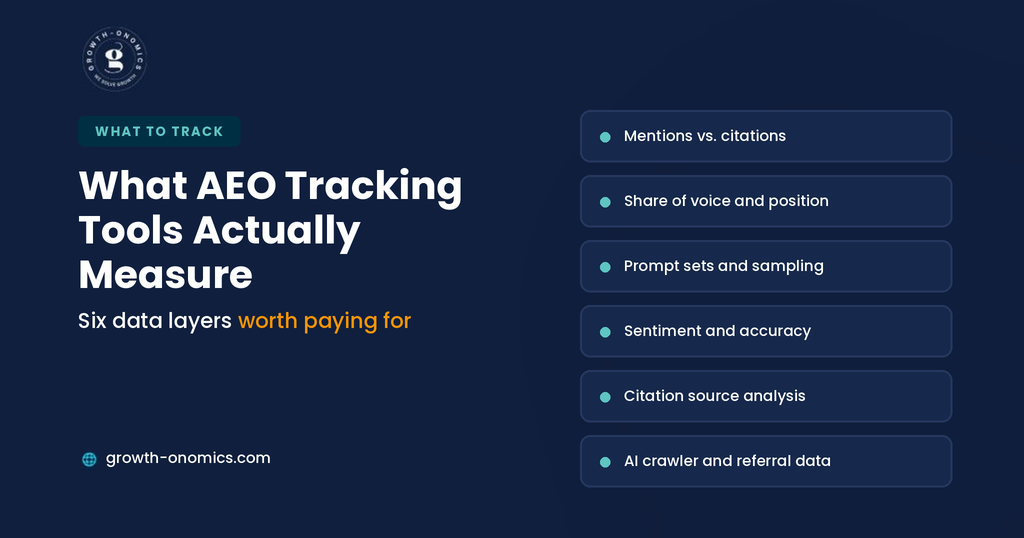
Vendors use the same words for different things, and the differences decide what you can act on.
Mentions Versus Citations
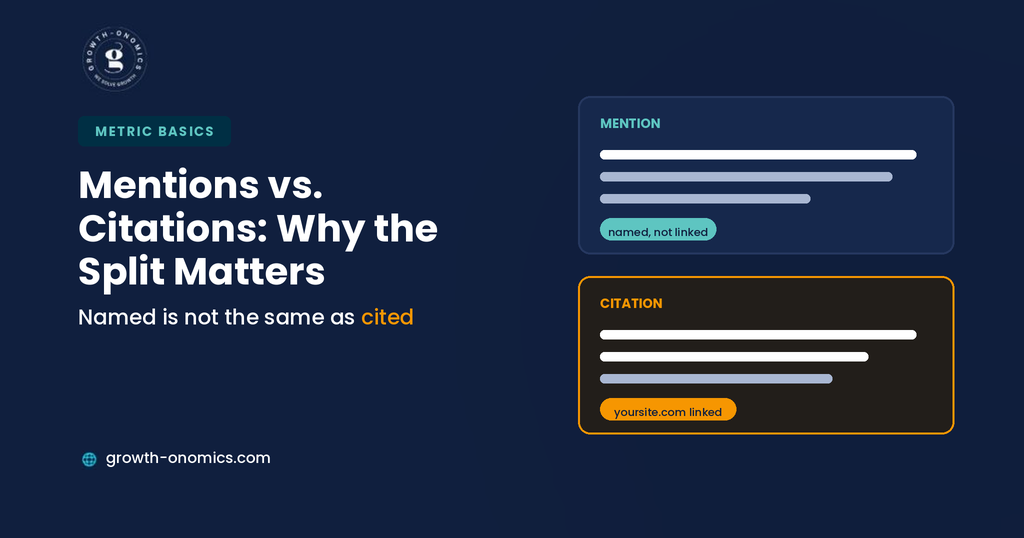
A mention means the model named your brand.
A citation means it linked your site as a source.
The two move independently: a brand can be recommended constantly without its pages ever being cited, because the model is drawing on review platforms, community threads, or roundups. Tools reporting only a blended score hide the most useful split in the data.
Share of Voice and Position
Share of voice expresses how often you appear across a prompt set compared with named competitors, and some tools add position within a recommended list. Treat both as directional: they depend entirely on the prompts you chose.
Prompt Sets and Sampling
Almost every tool runs synthetic prompts on a schedule rather than observing real conversations. Models personalize, results shift between runs, and weekly sweeps miss what happens in between.
A few platforms add panel- or search-derived data on what people actually ask.
Sentiment and Accuracy
Presence is not the same as being described well. An assistant listing deprecated features or misstating your pricing is a commercial problem, and fixing it usually means updating the sources the model relies on.
Citation Source Analysis
The most actionable report in these platforms lists the domains and URLs engines cite when answering your prompts. It tells you whether the battleground is your documentation, a comparison site, or a review platform, and therefore whether the next move is content, digital PR, or profile management.
Growth-onomics builds its brand mentions and listings work from exactly this analysis.
Crawler Data and Known Limits
A smaller group of tools tracks which AI crawlers visit your site and how much referral traffic arrives from assistants, which helps diagnose why a sound page never gets cited. No platform sees inside a model’s retrieval logic, though. Every number is an observation of outputs, so treat definitive-looking rankings as sampled estimates and trust direction over single readings.
1. Profound: Best Overall for Enterprise AI Visibility Intelligence
Website: tryprofound.com
Tracks: The broadest coverage here on higher tiers, including ChatGPT, Perplexity, Claude, Gemini, Copilot, AI Overviews, and AI Mode
Best for: Large teams and agencies needing depth, governance, and reporting that survives executive scrutiny
Profound is the most heavily funded platform here, and it treats AI visibility as an intelligence problem rather than a rank-tracking one.
What It Tracks
Brand presence, citation patterns, sentiment, and competitive position, plus how AI crawlers and agents interact with your site through Agent Analytics.
Standout Capability
Conversation Explorer surfaces what people actually ask AI systems in your category rather than leaving prompt selection to guesswork. With its agent-based action layer, it is the closest thing here to a closed loop.
Reporting and Data Access
API access, exports, separate workspaces for brands or clients, and enterprise controls including SOC 2 Type II and single sign-on.
Integration Options
Connects to web infrastructure and analytics so agent activity and AI-driven traffic sit alongside existing data.
Best For
Enterprises and agencies with a dedicated owner for AI visibility.
Potential Considerations
The most expensive tier of the market, with self-serve plans that shifted repeatedly through 2026. Reviewers note the depth can encourage tracking more than a team can act on.
2. Peec AI: Best for Mid-Market Teams and Agencies
Website: peec.ai
Tracks: 6 major engines including ChatGPT, Perplexity, Gemini, Claude, Copilot, and AI Overviews
Best for: Growing teams and agencies needing multi-country monitoring without an enterprise contract
What It Tracks
Mentions, citations with the specific URLs engines reference, competitor benchmarking, and share of voice across countries and languages.
Standout Capability
Regional segmentation. For SaaS companies selling into several markets, knowing you are cited in one country and absent in another is a strategic input few tools at this level expose.
Reporting and Data Access
Dashboards readable without an analyst, plus API access and a Looker Studio connector. Seats are not metered the way most tools meter them.
Integration Options
BI connectors blend AI visibility with organic and paid reporting; some engines are modular add-ons.
Best For
Mid-market SaaS teams wanting credible citation tracking with fast setup.
Potential Considerations
Concentrates on monitoring, so content and technical work happen elsewhere, and prompt demand data needs another source.
3. Semrush AI Visibility Toolkit: Best for Teams Already Running Semrush
Website: semrush.com
Tracks: ChatGPT, Perplexity, Gemini, Copilot, and Google AI Overviews, with AI Mode coverage in the wider suite
Best for: Teams that already own Semrush and want AI visibility without another vendor
What It Tracks
Mentions and share of voice across AI surfaces, how models describe your brand, competitor visibility, and site issues blocking AI crawlers.
Standout Capability
Perception reporting. Rather than counting appearances, it reports how platforms characterize a brand, which is the output that gets attention in a leadership meeting.
Reporting and Data Access
Dashboards built for stakeholders, with daily prompt tracking on higher tiers and a prompt database behind the estimates.
Integration Options
Sits inside the wider Semrush platform, so AI visibility reports next to classic organic performance.
Best For
In-house teams wanting one subscription covering search and answer-engine visibility.
Potential Considerations
Priced as an add-on on an existing subscription, and lighter than dedicated platforms on citation sources and crawler behavior.
4. Ahrefs Brand Radar: Best for Prompt Data and Citation Evidence
Website: ahrefs.com
Tracks: 6 or more AI platforms including Google AI Overviews, ChatGPT, and Perplexity
Best for: SEO and content teams in Ahrefs wanting visibility grounded in observed prompts
What It Tracks
Mentions, citations, impressions weighted by search volume, and AI share of voice, drawn from a very large monthly prompt index, alongside branded search demand, publications citing your brand, and YouTube mentions.
Standout Capability
Scale of the prompt corpus. Because the index is built from observed queries rather than only from invented ones, its estimates carry different evidence than those of synthetic-only tools.
Reporting and Data Access
An overview report with competitor comparison, topic breakdowns, and historical trends inside Ahrefs.
Integration Options
Native to the suite, so visibility sits beside Site Explorer and Site Audit data, with API access available.
Best For
Data-led teams seeking AI visibility and its search drivers in one view.
Potential Considerations
Costs climb as platforms are added, testers report gaps between platform figures and manual checks, and data updates on a snapshot cadence.
5. Otterly.AI: Best Entry-Level Citation Monitoring
Website: otterly.ai
Tracks: ChatGPT, AI Overviews, Perplexity, and Copilot in core plans, with Gemini, AI Mode, and Claude as add-ons
Best for: Small teams, freelancers, and agencies wanting monitoring running the same day
What It Tracks
Brand mentions, website citations, and competitive benchmarking, with alerts on shifts and prompt-level detail on which queries triggered each result.
Standout Capability
Time to value. Teams routinely have a prompt set live within an hour, which makes it a practical way to build the internal case before committing budget.
Reporting and Data Access
Straightforward reports on prompts, mentions, links, and competitors, aimed at practitioners.
Integration Options
Runs standalone alongside an existing SEO stack; agencies use it for lightweight client reporting.
Best For
Early-stage SaaS teams needing reliable monitoring at the lowest entry cost.
Potential Considerations
Prompt limits on entry tiers get restrictive as coverage grows, several engines sit behind add-ons, and there is no optimization layer.
6. Scrunch AI: Best for AI Crawler and Agent Readiness
Website: scrunch.com
Tracks: 7 or more engines including ChatGPT, Claude, Perplexity, Gemini, Meta AI, AI Overviews, and AI Mode
Best for: Technical teams and enterprises treating AI agents as a distinct audience
What It Tracks
Brand presence, share of voice, position within responses, sentiment, citations, AI bot traffic, and AI referrals, plus audits of how agents access your pages.
Standout Capability
Its Agent Experience Platform serves AI-optimized content to agents without changing the human-facing site, a different answer to making content machine-readable.
Reporting and Data Access
Monitoring, auditing, and optimization modules with enterprise security posture and persona-based segmentation.
Integration Options
Built for enterprise environments with multiple brands, regions, and languages.
Best For
Enterprises wanting visibility data and crawler diagnostics from one platform.
Potential Considerations
Prompt credits are consumed per engine, so multi-platform tracking scales quickly in cost, and the agent delivery layer was rolled out in stages.
7. AthenaHQ: Best for Guided Optimization
Website: athenahq.ai
Tracks: 8 or more AI models across the major answer engines
Best for: Growing teams wanting recommendations attached to the data
What It Tracks
Cross-platform visibility, citation source analysis, competitor gaps showing prompts where rivals appear and you do not, and sentiment.
Standout Capability
Turning gaps into recommended actions. Without a dedicated AEO specialist, a prioritized list of fixes is what decides whether a tool gets used or cancelled.
Reporting and Data Access
Credit-based usage with analytics integration so visibility sits alongside site performance.
Integration Options
Connects to Google Analytics for fuller-funnel context on sessions and conversions.
Best For
Mid-market SaaS teams needing measurement and direction from one subscription.
Potential Considerations
The credit model needs managing, and content execution still happens in your own stack.
8. Gauge: Best for Turning Visibility Data Into Action
Website: withgauge.com
Tracks: Major AI answer engines, with visibility broken down by platform and theme
Best for: Teams wanting the next action identified, not just the metric reported
What It Tracks
Visibility score, share of voice, average position, and competitor performance by platform and topic, plus prompt-level insight into which queries cite competitors instead.
Standout Capability
A workflow converting prompt and citation gaps into assigned recommendations, with content and research tooling in the same environment.
Reporting and Data Access
Reporting that connects AI visibility with analytics and Search Console data.
Integration Options
Plugs into existing analytics and content operations, and supports multi-client agency use.
Best For
Teams wanting tracking, prioritization, and execution support in one place.
Potential Considerations
Recommendations still need capacity to implement, coverage is strongest in English, and third-party review volume is thinner than for established suites.
9. SE Ranking AI Search Toolkit: Best for Google Surface Reporting
Website: seranking.com
Tracks: Google AI Overviews, Google AI Mode, Gemini, ChatGPT, and Perplexity
Best for: SEO teams needing AI visibility inside an affordable all-in-one platform
What It Tracks
Prompts, mentions, website links, positions, competitors, and trends, reported separately per surface rather than merged into one score.
Standout Capability
Clean separation of Google’s surfaces. AI Overviews, AI Mode, and chat interfaces behave differently, so distinguishing them explains why visibility moved in one place and not another.
Reporting and Data Access
Historical data and competitor comparison alongside rank tracking, audits, and backlinks.
Integration Options
Sits inside an established toolkit with white-label reporting, which suits agencies combining SEO and AEO reporting.
Best For
SEO teams folding AI visibility into existing client reporting at modest cost.
Potential Considerations
Engine coverage and refresh cadence trail the dedicated platforms, and it is most valuable to teams already committed to the suite.
Tool Comparison Chart
| Tool | Mentions vs. Citations | Citation Sources | Crawler Data | Prompt Demand Data | Recommendations |
| Profound | Yes | Strong | Yes | Yes | Yes, agent-based |
| Peec AI | Yes | Strong | Not core | Not core | Limited |
| Semrush AI Visibility Toolkit | Yes | Moderate | Crawler-blocking audit | Prompt database | In-suite guidance |
| Ahrefs Brand Radar | Yes | Strong | Not core | Large prompt index | Not core |
| Otterly.AI | Yes | Moderate | No | No | Prioritization hints |
| Scrunch AI | Yes | Strong | Core specialty | Not core | Yes, with delivery layer |
| AthenaHQ | Yes | Strong | Not core | Not core | Core specialty |
| Gauge | Yes | Strong | Not core | Not core | Core specialty |
| SE Ranking | Yes | Moderate | Not core | Not core | Limited |
How We Selected These AEO Tools
Every tool was assessed against 7 criteria: engine coverage relative to where B2B buyers research; whether mentions and citations are reported separately; quality of citation source analysis; prompt flexibility and sampling method; reporting depth and data access; support for action as well as measurement; and suitability across team sizes.
Only tools with public documentation of their tracking capabilities were included. This is a comparison based on vendor documentation and secondary sources rather than a controlled test, and no vendor paid for inclusion.
There is one caveat, though: independent testing has repeatedly found discrepancies between platform-reported visibility and manual spot checks, because every tool samples a probabilistic system.
Red Flags When Evaluating an AEO Tracking Tool
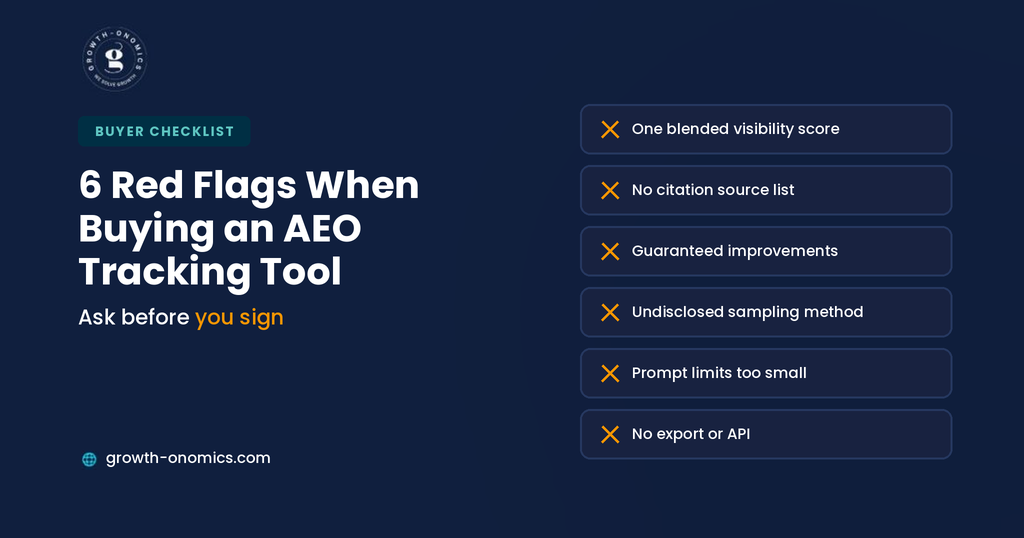
- A single blended visibility score. If you cannot see mentions, citations, and position separately, you cannot diagnose anything.
- No citation source list. Knowing which domains are cited instead is the half that produces a plan.
- Guaranteed improvements. No vendor controls retrieval, so any promise of citations is a promise about someone else’s system.
- Undisclosed sampling. Ask how often prompts run, from which regions, and whether results are averaged.
- Prompt limits too small for your category. B2B SaaS usually needs a few hundred prompts across buyer stages, not twenty.
- No export or API. Data that cannot leave the dashboard cannot be joined to pipeline reporting.
How to Build an AI Citation Tracking Program
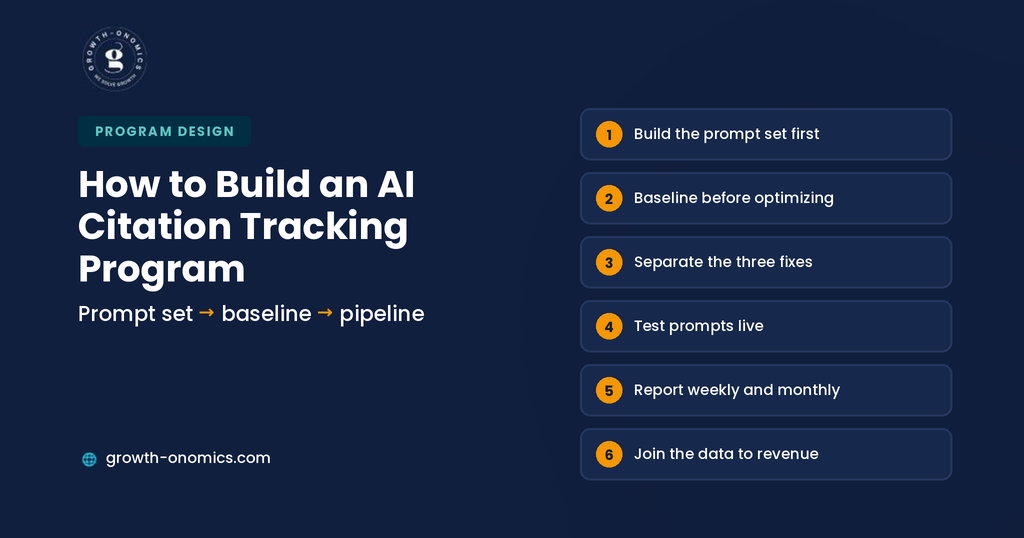
Buying a tool is the easy part. Teams getting value here treat tracking as a program.
Start with the prompt set, not the platform. Your prompt list is the measurement instrument. Build it from how buyers research: category definitions, comparison and alternatives queries, integration and security questions, pricing phrasing, and the problems people describe before they know your category name.
Include competitor-branded prompts, because that is where displacement happens.
Establish a baseline first. Run the full set for two to four weeks before optimization begins, or you cannot separate your work from ordinary volatility. This is the stage Growth-onomics runs as an AI readiness audit, because everything afterwards is measured against it.
Separate the 3 fixes. Citation data points to one of three problems: the model cannot parse your content, the content does not answer the prompt in extractable form, or third-party sources outweigh your site. Each has a different owner, and conflating them is why programs stall.
Test prompts live, not just on the dashboard. Synthetic sampling misses phrasing variants and personalization, and manual testing across regions catches what the tool averages away. Live prompt testing is a defined step in the Growth-onomics AI Optimization framework for this reason.
Set a cadence you will keep. Weekly sessions on movement and monthly reporting on trend and business impact suits most SaaS teams, and mirrors how AEO agencies reports: visibility metrics alongside organic performance, referral traffic, and influenced pipeline.
Connect the data to revenue. Export citation and share-of-voice data, join it to analytics and CRM data, and track assisted conversions and influenced pipeline. A program measured only in mentions will eventually lose its budget.
Questions to Ask Before Buying an AEO Tool
- Which engines are included at my tier, and which are paid add-ons?
- How often do prompts run, and from which countries and languages?
- Do you report mentions and citations separately, with source URLs?
- Can I see position within a recommendation list, not just presence?
- How many prompts can I track, and what happens when I exceed that?
- Is there an API or BI connector, and can I export historical data?
- How do you handle multiple brands, sub-brands, or client workspaces?
- How have your figures held up against manual verification?
- What happens to my historical data if I cancel?
Conclusion
These tools do genuinely different jobs. Profound and Scrunch serve enterprises needing technical depth. Peec AI and Otterly.AI serve growing teams needing clean monitoring at sensible cost. Semrush, Ahrefs, and SE Ranking suit teams consolidating reporting inside a suite they own. AthenaHQ and Gauge lean toward telling you what to fix.
What none of them do is the work. A dashboard reports that your brand appeared in 14% of tracked answers; it does not restructure the comparison page, earn the mention that changes the source mix, fix the rendering issue blocking a crawler, or decide how to proceed. That judgment is the program layer, and it decides whether tracking data becomes pipeline or a slide.
Growth-onomics works at exactly that layer. Our AI Optimization framework runs an AI readiness audit across ChatGPT, Google AI Overviews, Copilot, and Perplexity, refines content and structure, builds brand mentions and third-party listings, tests prompts live to measure citation rates, and tunes continuously as models change with reporting that sets share of voice and citation counts next to organic performance, conversions, and pipeline.
If you are choosing a tool, pick the one that fits your team and stack. If you want tracking connected to a program that moves the number, tell us your category and we will show you where your brand appears in AI answers today, which sources are cited instead, and what a realistic plan looks like.
FAQs
What is the difference between a brand mention and a citation in AI answers?
A mention means the model named your brand in the answer text. A citation means it linked your website as a source. They often diverge: a product can be recommended in most answers without a single link to its own site, because the model is drawing on review platforms or community discussions. Strong mentions with weak citations point to a content and technical problem on your domain; weak mentions overall point to an authority problem off it.
Do I need a dedicated AEO tool or is my SEO platform enough?
If you already run Semrush, Ahrefs, or SE Ranking, start with the AI module you are entitled to, since it answers the first-order questions without a new contract. Move to a dedicated platform when you hit real limits: engines the suite does not cover, deeper citation source analysis, crawler data, larger prompt sets, or an API. Buying a full suite purely for its AI add-on rarely makes sense; upgrading because the add-on ran out of room usually does.
How accurate are AI visibility tracking tools?
They are estimates rather than measurements. Every tool samples a probabilistic system, and answers vary by phrasing, region, account history, and timing. Independent testing has found meaningful discrepancies between platform figures and manual verification. Use them for direction over time rather than precision, keep the prompt set stable so trends mean something, and verify anything surprising by hand.
How many prompts should a B2B SaaS company track?
Enough to cover the buying journey, usually one to three hundred prompts rather than a handful. Cover category definitions, comparison and alternatives queries, integration and security questions, pricing phrasing, and the problems buyers describe before they know your category name. Include competitor-branded prompts, since displacement shows up there first. Beyond that, more prompts mainly add cost and noise.
Can these tools show whether AI visibility drives revenue?
Partially. Several platforms report assistant referral traffic and integrate with analytics so visibility sits beside sessions and conversions. But those referrals are commonly undercounted, many AI-influenced buyers arrive later through branded search, and no tool sees the conversations that shaped a shortlist before anyone clicked.
Treat AI visibility as an influencing channel measured through assisted conversions and pipeline trends rather than last-click revenue.
How often should we check AI citation data?
Weekly for movement, monthly for decisions. Daily checking invites overreaction, since outputs fluctuate for reasons unrelated to anything you did. A weekly review catches genuine drops, new competitors, and inaccurate descriptions early enough to respond. Monthly suits trend reporting, since content and authority work takes weeks to register.
Do AI visibility tools work for non-English markets?
Coverage varies and is worth testing before committing. Some platforms treat multi-country and multi-language tracking as a core capability, which matters if you need to know you are cited in one market and invisible in another. Others are strongest in English. Ask which languages and countries are supported at your tier and whether competitor benchmarking works per market, then test on your own prompts during a trial.
Should we use more than one AEO tracking tool?
Many teams do, at least temporarily. A common pattern is one dedicated platform for depth plus a suite module for reporting continuity. Running two briefly is also the most reliable way to evaluate accuracy, since discrepancies tell you how much confidence any single figure deserves. What rarely works is maintaining several indefinitely: prompt sets drift, figures disagree, and reporting time expands.