


Referral traffic is undergoing a major transformation in 2026. Here’s what you need to know:
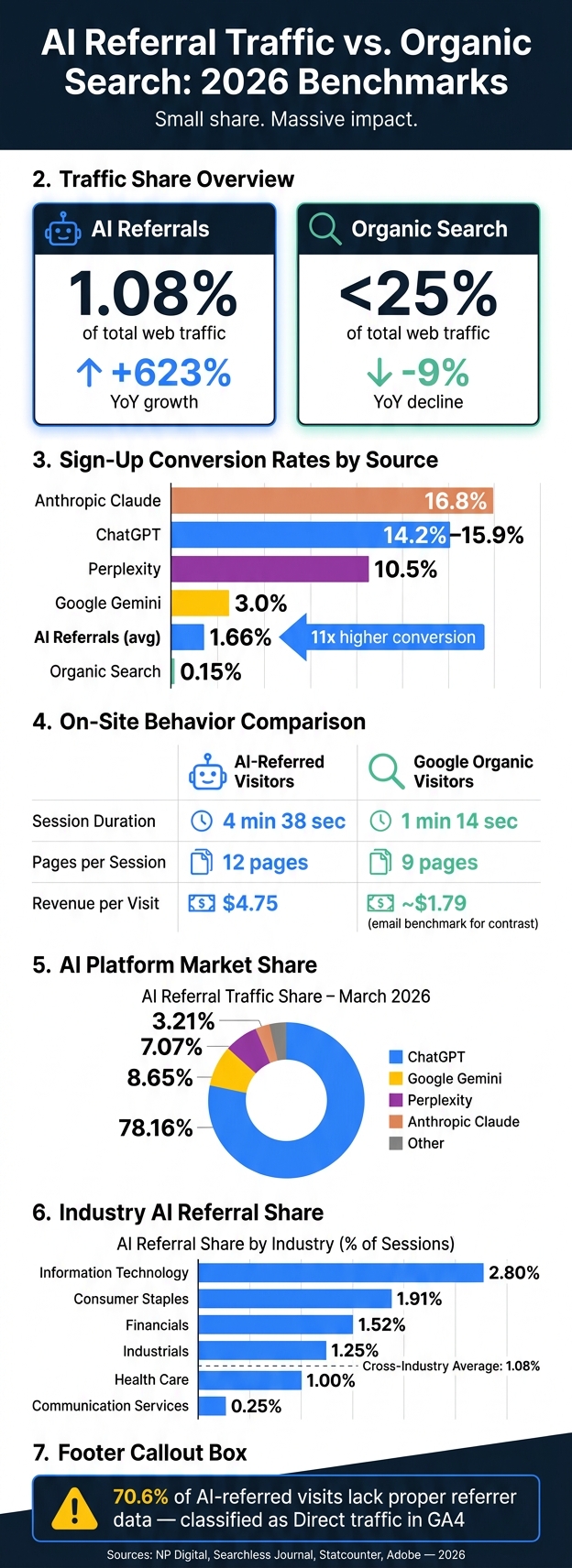
- AI-driven referrals are exploding, growing 623% year-over-year by April 2026, but still account for just 1.08% of total web traffic.
- Visitors from AI platforms like ChatGPT, Claude, and Google Gemini convert at much higher rates (up to 16.8%) compared to organic search (0.15%).
- Organic search traffic is declining, down 9% this year, now making up less than 25% of total web traffic.
- New tools like GA4’s custom channel grouping make tracking AI referrals easier, addressing the issue of "Dark AI Traffic", where 70.6% of visits lack proper attribution.
Key takeaway: AI referrals may be a small slice of traffic, but they deliver high-intent visitors who spend more time on-site, convert at higher rates, and generate more revenue. Businesses need to refine tracking and prioritize visibility in AI-generated citations to stay competitive.
AI Referral Traffic vs. Organic Search: 2026 Benchmarks
Main Referral Traffic Sources in 2026
Types of Referral Traffic Sources
In 2026, referral traffic falls into three main categories. First, traditional web referrals come from links on other websites, such as industry blogs, news outlets, partner sites, and directories. Second, social platforms contribute traffic through both organic posts and paid ads on platforms like LinkedIn, Facebook, and Instagram. Finally, AI-driven referrals emerge as a growing force, with platforms like ChatGPT, Google Gemini, Anthropic’s Claude, and Perplexity leading the charge. Each category offers unique strengths, particularly when it comes to conversion rates, making it crucial to understand how they impact acquisition strategies. Let’s take a closer look at the rapid growth and impressive performance of AI-driven referrals.
The Rise of AI-Driven Referrals
AI referrals saw a staggering 357% year-over-year growth through 2025. Despite this surge, these sources still represent a small fraction of overall web traffic – ranging from 0.14% to 1.08%, depending on the industry. What sets AI referrals apart is their conversion quality. Visitors from AI sources convert at a rate of 1.66%, compared to just 0.15% for organic search. Among AI platforms, Anthropic’s Claude leads with a 16.8% sign-up conversion rate, followed by ChatGPT at 14.2%–15.9%, and Google Gemini at 3.0%.
The disparity in performance across industries is equally striking. For example, the Information Technology sector sees an AI referral rate of 2.80%, while Communication Services lags at just 0.25%. Neil Patel, Co-Founder of NP Digital, highlights this variability:
"The 11x spread between Information Technology and Communication Services AI referral rates tells you that ‘average’ is almost meaningless here."
This explosive growth in AI referrals signals a shift in how businesses will approach referral channels and SEO content strategy moving forward.
How the Referral Channel Mix Is Changing
The landscape of referral traffic is undergoing significant changes in 2026. Organic search is losing ground, while paid social has grown by 18%, now accounting for 10.5% of total traffic. Meanwhile, AI referrals are gaining momentum but face challenges with attribution – about 70.6% of AI-driven visits lack proper referrer data and are categorized as "Direct" in analytics tools. A notable update on May 7, 2026, to ChatGPT’s interface, which made brand names more prominent and clickable, caused homepage referrals to spike by 354.7% almost overnight. This highlights how quickly AI-driven channels can evolve.
Adelle Kehoe, Director of Product Marketing at Similarweb, offers an intriguing perspective:
"The future of search may not be ‘no clicks.’ It may just be different clicks. Earlier in the funnel, brand-level, and driven by conversational discovery."
The AI referral market itself is becoming more diverse. ChatGPT’s dominance dropped from 86.7% in early 2025 to 78.16% by March 2026. Meanwhile, Google Gemini’s share tripled year-over-year, reaching 8.65%. Platforms like Claude and Perplexity are also carving out niches, making it essential for businesses to adopt a multi-platform strategy to capitalize on this growing traffic source.
| AI Platform | Referral Share (March 2026) | Sign-Up Conversion Rate |
|---|---|---|
| ChatGPT | 78.16% | 14.2%–15.9% |
| Google Gemini | 8.65% | 3.0% |
| Perplexity | 7.07% | 10.5% |
| Anthropic Claude | 2.91% | 16.8% |
Source: Statcounter/Searchless Journal
sbb-itb-2ec70df
BIG Update: AI Referral Traffic Is Now Measurable
Referral Traffic Benchmarks for 2026
As referral channels continue to evolve, the following benchmarks shed light on key performance metrics across industries and sources for 2026.
Traffic Volume and Share by Industry
Referral traffic now makes up 9.60% of total web visits, reflecting a notable 53.39% growth in 2025. AI-driven referrals contribute an average of 1.08% of sessions, though this percentage varies significantly depending on the industry.
For example, Information Technology leads with 2.80%, while Communication Services lags behind at just 0.25%. The Travel & Hospitality sector has seen explosive growth, with AI referral orders surging by 1,700% between July 2024 and February 2025. Similarly, Consumer Staples and Financial Services each experienced impressive growth of 1,200% during the same period.
| Industry Vertical | AI Referral Share (% of Total Sessions) |
|---|---|
| Information Technology | 2.80% |
| Consumer Staples | 1.91% |
| Materials | 1.61% |
| Industrials | 1.25% |
| Health Care | 0.64%–1.5% |
| Financials | 1.52% |
| Communication Services | 0.25% |
| Cross-Industry Average | 1.08% |
Source: NP Digital / Conductor 2026 Study
These figures provide a foundation for examining conversion performance across referral sources.
Conversion Rates by Referral Source
Understanding conversion rates offers deeper insights into the quality of referral traffic. AI-driven referrals boast conversion rates ranging from 3.49% to 4.21%, with revenue per visit averaging $4.75 – a stark contrast to $3.06 for Google Ads and $1.79 for email.
Platform-level data reveals even more about performance differences. Claude stands out with a 16.8% sign-up conversion rate, followed by ChatGPT at 14.2%–15.9%, Perplexity at 10.5%, and Gemini at 3.0%. To put this into perspective, traditional organic search achieves just a 0.15% sign-up conversion rate.
AI-referred visitors also show distinct on-site behaviors. They spend an average of 4 minutes 38 seconds per session, compared to just 1 minute 14 seconds for Google organic visitors. Additionally, they view 12 pages per session, outpacing the 9 pages viewed by Google visitors.
"AI traffic is already a worthwhile budget line for any brand whose category has meaningful AI conversation volume. The question isn’t whether to optimize – it’s how to win citations." – Chris Coussons, Founder, Visionary Marketing
Customer Value and ROI from Referral Traffic
Referred customers consistently outperform those acquired through paid channels across all long-term value metrics. They exhibit 16% higher lifetime value, 37% better retention, and 25% greater first-purchase spending. Additionally, referred visitors are 4x more likely to make a purchase and 30–57% more likely to refer others, creating a ripple effect that boosts long-term value.
Referral channels also offer a clear cost advantage. The average customer acquisition cost (CAC) via referral channels is $45, compared to $74 for paid search – a 39% savings. This cost benefit grows over time as referred customers continue to spend more and stay loyal longer.
Jaxon Parrott, Founder & CEO of AuthorityTech, explains why AI-driven referrals deliver such strong results:
"The conversion premium is not accidental. It is structural… The visitor arrives with intent already focused and trust already partially established."
These advantages underline the importance of refining referral strategies to drive sustainable growth.
How to Track and Measure Referral Traffic
Tracking referral traffic accurately has become more important than ever. With AI platforms now driving a growing share of referral sessions, particularly in 2026, refining your tracking methods is essential to ensure you’re capturing this data correctly.
Using GA4 to Track Referral Traffic
Google Analytics 4 (GA4) remains a key tool for tracking referral traffic, but the default setup has its limitations. In late 2025, Google introduced a "AI Assistant" channel group that automatically categorizes traffic from platforms like ChatGPT, Gemini, and Claude using medium=ai-assistant. While helpful, this feature doesn’t cover all bases.
To take it a step further, consider creating a custom channel group (you could name it "AI Engines") using a regex pattern to include major AI sources:
^(chatgpt\.com|perplexity\.ai|claude\.ai|gemini\.google\.com|copilot\.microsoft\.com|you\.com|phind\.com|poe\.com)
Make sure this rule is prioritized above the default "Referral" and "Organic Search" rules for accurate attribution. Additionally, exclude self-referrals from tools like Stripe or PayPal through GA4 Admin settings. Standardizing on utm_medium=ai_search for controlled links ensures attribution remains intact, even when referrer headers are missing.
This setup helps distinguish AI-driven traffic from generic "Direct" traffic, giving you a clearer picture of where your visitors are coming from.
How Analytics Tools Are Classifying AI Referrals
One major challenge is that 70.6% of AI-referred visits arrive without an HTTP referrer, meaning GA4 often categorizes them as "Direct / (none)". This phenomenon, called "Dark AI Traffic", can make tracking tricky.
"Dark AI traffic is humans, sent by an AI answer, wearing no identifying badge." – Vincent Ruan, Founder, Attrifast
The extent of this issue varies by platform. For example, Perplexity passes referrer data 50–70% of the time, making it somewhat trackable. Claude, however, passes referrers less than 5% of the time, meaning almost all its traffic ends up in the "Direct" bucket. A useful indicator: if your "Direct" traffic is increasing while branded search traffic in Google Search Console remains flat, you may be dealing with Dark AI Traffic.
For those seeking more precise data, server-side logging offers a more comprehensive solution, often identified during technical SEO audits. In a 21-day audit of Attrifast.com conducted in May 2026, Cloudflare server logs identified 3,412 AI-referred sessions, while GA4 only reported 1,847. This means GA4 missed 1,565 sessions entirely.
Key Metrics and KPIs for Referral Traffic
Once you’ve identified referral traffic sources, it’s important to measure their performance with the right metrics. Focusing on volume alone can be misleading. As Will Tygart explains:
"The default GA4 referral view is sorted by volume. Volume is the wrong metric for understanding referral quality."
Instead, prioritize engagement rate. Any source with an engagement rate above 50% is worth focusing on, even if it sends fewer than 20 sessions per month. AI referrals, in particular, stand out for their impact: AI-sourced sessions convert at 4.4 times the rate of Google organic traffic and generate 37% more revenue per visit than non-AI traffic.
Here are some key metrics to track:
| Metric | Formula | 2026 Benchmark |
|---|---|---|
| Referral Conversion Rate | (Conversions from Referrals / Referral Sessions) × 100 | 4.4x higher than organic |
| Engagement Rate | (Engaged Sessions / Total Sessions) × 100 | >50% = high quality |
| Dark AI Share | (Inferred AI Sessions in Direct / Total Direct Sessions) × 100 | 34% median |
| AI Revenue per Visit (RPV) | Total Revenue from AI / Total AI Sessions | $1.12 (Perplexity), $0.84 (ChatGPT) |
For B2B teams, focus on metrics like sign-ups, demo requests, and contributions to the sales pipeline rather than pageviews. While AI traffic might represent only a small portion of total sessions, it often delivers a disproportionately large share of commercial outcomes.
Referral Traffic Trends and What They Mean for Your Business
Key Trends Shaping Referral Traffic in 2026
AI is continuing to reshape how referral traffic flows across the web. Between June 2024 and June 2025, AI-driven referrals skyrocketed by 357%, hitting 1.13 billion visits. Even with this massive growth, AI referrals still represent just 1.08% of total web traffic.
But here’s the kicker: quality beats quantity. Visitors referred by AI tools are more engaged and more likely to convert. AI-referred traffic boasts a conversion rate of 10.5%–16.8%, compared to the 2%–5% typically seen with organic traffic. These users also spend more time on-site (15 minutes vs. 8 minutes) and explore more pages per session (12 vs. 9). Why? They often come to your site after using AI tools to research and narrow down their options, meaning they’re already further along in their decision-making process.
Meanwhile, organic search is losing momentum. Between December 2024 and December 2025, organic traffic to publishers dropped by 34%, and over half of Google searches (56%) now end without a single click. This shift reflects a broader transition from a "retrieval" model, where users sift through links, to a "synthesis" model, where AI delivers direct answers.
"We are moving from a ‘Search Engine’ world – where users hunt for links – to an ‘Answer Engine’ economy, where platforms synthesize information for them." – Amit Bachbut, Director of Growth Marketing, Yotpo
Among AI platforms, ChatGPT leads the pack, holding a 78.16% share of AI referral traffic as of March 2026. However, competitors are gaining ground. Google Gemini saw a staggering 388% growth year-over-year, capturing 8.65% of the market, while Claude stands out with the highest conversion rate at 16.8%.
How Referral Traffic Differs by Industry
While overall trends provide a big-picture view, the impact of AI referrals varies widely across industries.
"The 11x spread between Information Technology and Communication Services AI referral rates tells you that ‘average’ is almost meaningless here. Set your GEO benchmarks against your vertical, not the cross-industry average." – Neil Patel, Co-Founder, NP Digital
| Industry | AI Referral Traffic Share |
|---|---|
| Information Technology | 2.80% |
| Consumer Staples | 1.91% |
| Materials | 1.61% |
| Financials | 1.52% |
| Health Care | 1.00% |
| Real Estate | 1.01% |
| Utilities | 0.35% |
| Communication Services | 0.25% |
For SaaS and tech companies, AI referrals are already making a noticeable impact. In April 2026, Ahrefs reported that while AI-driven traffic accounted for only 0.5% of visitors, it generated 12.1% more signups than expected. ChatGPT referrals converted at 15.9%, and Perplexity followed at 10.5%. In ecommerce, retail AI traffic surged by 343% year-over-year. Adobe’s analysis of over 1 trillion U.S. retail site visits revealed that AI-referred visitors converted 31% better than non-AI traffic during the 2025 holiday season.
Content-heavy publishers, on the other hand, face challenges. As organic search – a primary traffic source for these sites – continues to decline, they’re being squeezed by the rise of AI-driven answers.
What Businesses Should Do Next
These shifting patterns demand a fresh approach. Instead of focusing solely on rankings and visibility, businesses need to prioritize "share of source" – how often their brand is cited in AI-generated responses. With 83% of AI citations coming from third-party sources, being visible on platforms like G2, Capterra, Reddit, and industry-specific news outlets is more important than ever.
On the technical front, structured data is key. Using Schema markup for Organization, Product, and FAQPage ensures that AI crawlers can extract and cite your content accurately. Additionally, optimize landing pages for AI-referred visitors by highlighting pricing, specs, and key details upfront. Over half of AI-driven sessions start directly on product pages rather than homepages or blogs.
For businesses looking to take control, partnering with experts like Growth-onomics can help configure GA4 attribution, map high-intent customer journeys, and improve AI citation visibility.
"The battle is not for clicks. It is for citations. Every citation from an AI engine is a pre-qualified visitor who has already been told you are the answer." – Jaxon Parrott, CEO, AuthorityTech
Conclusion: Key Takeaways from 2026 Referral Traffic Research
Main Findings at a Glance
AI-driven traffic might account for just 1.08% of total visits, but its conversion rates are outperforming organic search by a wide margin. For instance, Claude referrals convert at 16.8%, while ChatGPT-driven traffic achieves rates between 14.2% and 15.9%.
Meanwhile, organic search is facing serious challenges. Google AI Overviews have caused a 58% reduction in organic clicks for queries where they appear. Additionally, 93% of searches in Google AI Mode conclude without a single external click. For small and mid-sized businesses that depend on organic traffic, these changes are already reshaping performance metrics.
The impact varies greatly by industry, so your business’s position in this spectrum should guide how you approach AI referral strategies.
"AI referral traffic is already punching well above its weight… The percentage of total traffic is the wrong metric. The conversion rate and pipeline contribution are the right metrics." – The Searchless Journal
These findings highlight the need for businesses to adapt quickly to changes in referral traffic dynamics.
How to Apply These Insights
The 2026 data underscores the importance of aligning your analytics with emerging AI trends to stay competitive. Start by updating your GA4 analytics to ensure AI referrals aren’t misclassified as "Direct" traffic. Custom channel groupings can help you track this traffic more accurately.
Next, focus on optimizing your content structure. Use tools like tables, concise statements, and Schema markup to make your content easier for AI platforms to reference. With over 50% of AI sessions starting on product pages, ensure these pages offer seamless next steps – prioritizing clarity and action over lengthy trust-building content.
For tailored strategies on improving GA4 tracking and mapping user journeys, check out Growth-onomics. Their expertise can help you navigate this shifting referral landscape effectively.
FAQs
How can I tell if ‘Direct’ traffic is actually AI referrals?
AI referrals often show up as Direct traffic in analytics because many platforms, like ChatGPT, remove or strip referrer headers. This can make it tricky to track their true origin. However, there are ways to uncover AI-driven traffic:
- Set up custom channel groups in GA4: For example, you can create a group to capture referrers like chatgpt.com or similar sources.
- Watch for unusual traffic spikes: If you notice unexplained increases in landing page visits that convert into leads, AI tools might be the source.
- Look for bot activity or citation signals: Check for signs like ChatGPT-User agents or other identifiable markers in your logs.
For a deeper understanding, advanced attribution techniques can help connect the dots and reveal how AI tools influence your traffic.
What’s the fastest way to track AI referrals in GA4 accurately?
To accurately track AI referrals in Google Analytics 4 (GA4), follow this two-step process:
- Set Up Custom Channel Grouping Rules
Create custom rules to identify AI referrers or UTMs, such as ‘chatgpt’ or ‘perplexity.’ Once set up, you can validate these rules by navigating to Reports → Acquisition → Traffic Acquisition in GA4. - Handle Missing Referrer Data
Many AI referrals show up as ‘Direct’ because they lack referrer information. To address this, log the HTTP referer and user-agent server-side. Then, use this data to reconcile with GA4 by implementing custom dimensions.
By combining these steps, you can ensure AI referrals are tracked more effectively in your analytics.
How can I increase my brand’s chances of being cited by AI engines?
To increase the likelihood of your brand being mentioned by AI engines, prioritize third-party corroboration. AI systems tend to rely on consensus from credible sources, and studies indicate that 82–89% of citations come from third-party editorial content.
To make your content AI-friendly, focus on these key elements:
- Use clear and concise Subject-Verb-Object sentence structures.
- Include at least 15 named entities (like people, places, or organizations) per page.
- Break down information into manageable sections of 120–180 words, structured with H1-H3 headers for easy navigation.
These strategies can help your content stand out in an AI-driven landscape.