

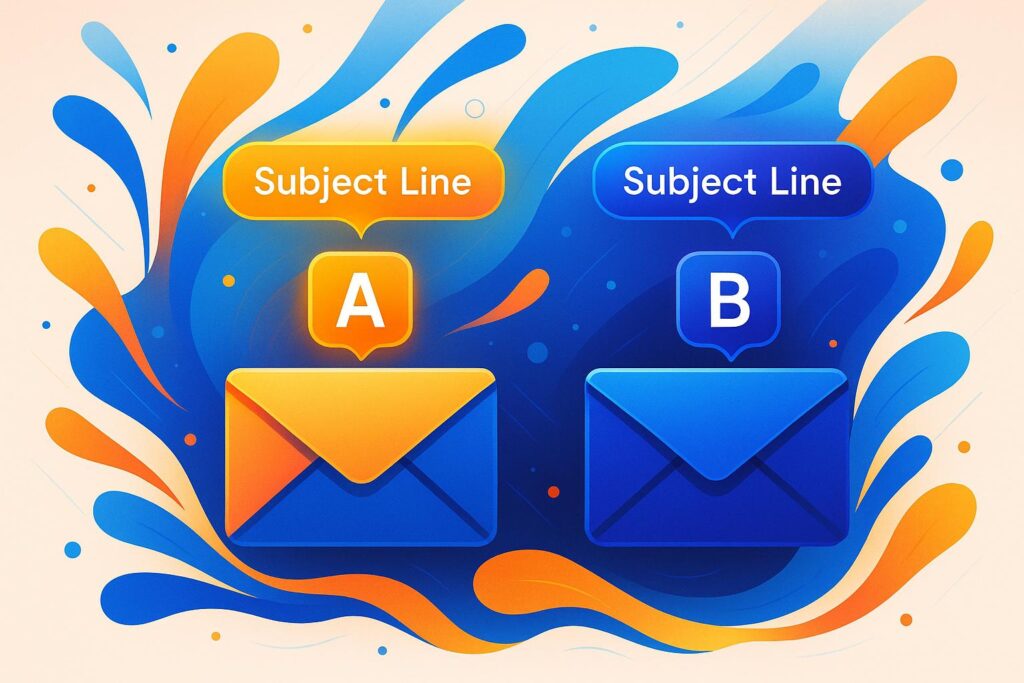
Want better email open rates? A/B testing subject lines is the way to go. Here’s how it works: create two subject line versions (A and B), send each to a small group, and see which one performs better. Then, send the winner to the rest of your list. It’s simple and effective.
Key Steps:
- Set Goals: Define what you want to improve – open rates, clicks, or conversions.
- Pick a Test Audience: Use a large enough sample for reliable results (1,000+ contacts is ideal).
- Choose Tools: Use email platforms like Mailchimp or Klaviyo to automate testing.
- Write Two Options: Test one element at a time (e.g., personalization, tone, or urgency).
- Keep Everything Else the Same: Ensure only the subject line changes.
- Launch the Test: Split your audience randomly and send both versions at the same time.
- Track Metrics: Focus on open rates, click-through rates (CTR), and conversions.
- Analyze Results: Look for patterns and ensure statistical significance.
- Use the Winner: Send the best-performing subject line to the rest of your list.
- Keep Testing: Regularly test to refine your strategy and adapt to audience preferences.
Why It Matters:
- 64% of users open emails based on subject lines.
- Personalized subject lines boost open rates by 14%.
- Email marketing delivers an average ROI of $36 for every $1 spent.
By following these steps, you can improve your email campaigns and better connect with your audience. Keep testing – it’s an ongoing process for better results.
How to A/B Test Email Subject Lines
Step 1: Set Clear Testing Goals
Before diving into subject line variations, take a moment to define your objectives. Without clear goals, it’s impossible to measure success or figure out which version performs better. Once your objectives are set, tie them to measurable metrics for a more focused approach.
Common goals for subject line testing include increasing email open rates, boosting click-through rates, and driving more conversions. Each of these requires a unique strategy for designing tests and measuring results.
Start by reviewing your current email performance. Are your open rates lagging behind industry benchmarks? If so, focus on crafting subject lines that entice more users to open your emails. On the other hand, if your emails are being opened but not clicked, work on subject lines that better align with the email’s content and set clearer expectations.
Set specific, actionable targets. For instance, aim to improve open rates by 5% compared to your current baseline. Having a clear benchmark ensures you can evaluate whether your test results are meaningful.
Make sure your goals align with your broader business objectives. For example, if lead generation is a priority, focus on conversions. If brand awareness is your aim, prioritize engagement metrics.
The potential impact of well-planned tests can be significant. Coalition Technologies, for example, ran several targeted experiments. One team tested send times for golfers and achieved open rates above 40% and click-through rates over 5%. Another experiment focused on finding the best day to send emails, resulting in open rates of 60% and click-through rates of 6%. Testing CTA text across different email topics also led to a 30% increase in revenue directly attributed to email campaigns.
To sharpen your testing strategy, ask yourself key questions: Why are you testing this variable? What insights are you hoping to gain? How will these insights improve your campaign performance?. These questions help ensure your tests are purposeful and aligned with your marketing goals.
And don’t forget: 64% of email recipients decide whether to open an email based solely on the subject line. This highlights just how critical it is to set clear, measurable goals for your subject line A/B tests.
Step 2: Choose Your Test Audience
Picking the right test audience is crucial for accurate A/B test results. To ensure your findings represent your entire email list, you’ll need a group large enough to provide statistically reliable data.
For most email A/B tests, a minimum of 1,000 contacts is recommended. This size helps you effectively sample your list. If your list is smaller, you can split it in half – sending one version of the email to one half and the other version to the other half.
Fine-Tune Your Sample Size
To get more precise, use sample size calculators. Tools like Evan Miller‘s calculator, Optimizely, CXL, Unbounce, or Convertize let you input key metrics like baseline conversion rate, minimum detectable effect (MDE), and desired statistical significance. Starting with a smaller MDE – around 5% – can help you uncover more detailed insights, though it may require a larger audience. Klaviyo also suggests using a proportional approach, such as testing 20% of your list with one version and another 20% with the other.
Random and Balanced Segmentation
Once your sample size is set, divide your audience into two equal groups randomly. This ensures each group is balanced in terms of demographics and behavior, reducing bias. For reliable results, platforms like Mailchimp recommend having about 5,000 subscribers per test group.
Segment Based on Your Goals
Tailor your audience segmentation to align with your testing objectives. Use factors like demographics, purchase history, or engagement patterns to create targeted groups. For instance, if you’re testing a product-related email, focus on subscribers who’ve shown interest in similar products or services. Aim for homogeneity within segments and consider external factors like email client variations to keep your results consistent.
Step 3: Pick the Right Testing Tools
Selecting the best email marketing platform can take the guesswork out of figuring out which subject lines deliver results. A good platform not only handles the technical side of A/B testing but also provides clear insights into performance metrics.
Your platform should be equipped to split your audience automatically, test variations, and analyze results statistically. By automating these processes, you minimize human error and ensure your results are accurate and reliable.
Key Features to Look For
An ideal email marketing platform will automatically track metrics like open rates, click-through rates, and conversion rates. However, it’s not enough to just see the raw data – look for tools that offer statistical analysis to identify the true winner. This gives you the confidence to choose the most effective subject line.
"A successful email starts with a subject line that grabs the attention of your recipients." – Mailchimp
Some platforms also provide AI-powered tools and predictive analytics. These features can suggest subject lines or even predict which ones are likely to perform better before you hit send.
Comparing Platforms and Costs
Platforms differ significantly in their A/B testing capabilities and pricing. For basic plans, expect to pay between $10 and $30 per month. Premium plans, which include advanced analytics and customization options, come at a higher price but offer greater flexibility and insights.
Advanced Reporting Capabilities
Top-tier platforms go beyond simply naming the winning subject line. They provide detailed reporting dashboards that explain why one variation outperformed another. Look for tools that break down performance by audience segments, time of day, and even device type. This detailed information can help you spot trends and refine your strategy for future campaigns.
For e-commerce businesses, platforms that track revenue as a metric are particularly valuable. Research shows companies focusing on revenue metrics in their tests earn 20% more from email campaigns compared to those prioritizing just open rates. This type of insight can make a big difference in your campaign’s success.
Expert Assistance
If you’re unsure which platform suits your needs, expert advice can be a game-changer. Growth-onomics offers tailored recommendations to help you choose the right tools for your campaign. Their team specializes in performance marketing and data analytics, ensuring your platform aligns with your goals, audience size, and budget. They’ll guide you in selecting a tool that not only simplifies testing but also delivers actionable insights.
Ultimately, your platform should be easy to use while offering robust data capabilities. With the right tool in place, you’ll be ready to craft subject line variations that resonate with your audience in the next step.
Step 4: Write Two Subject Line Options
Crafting effective subject line variations requires a sharp focus. With 64% of email recipients deciding to open an email based solely on the subject line, each variation you create should test just one specific element. This approach ensures you can clearly identify what drives performance, without muddying the results.
The key to A/B testing subject lines is straightforward: only change one thing at a time. Whether it’s tone, length, or a specific word, keeping your tests focused allows you to pinpoint what works – and what doesn’t.
Start by revisiting your testing goal and hypothesis. What do you want to learn about your audience? Once you’ve nailed that down, create subject line variations that align with your hypothesis. For example, if you’re curious about whether personalization improves open rates, compare a subject line like “Hi [Name], Unlock the Secrets of A/B Testing!” with a more general one, such as “How to Craft Winning Email Subject Lines with A/B Testing.” This small tweak can reveal if your audience prefers a personal touch.
You can also experiment with other elements, such as:
- Benefits vs. Features
Example: “Unlock Higher Click Rates with Our New Email Design Tools” vs. “New Email Design Tools Available Now!” - Urgency
Example: “Last Chance! A/B Testing Secrets Revealed” vs. “The Ultimate Guide to A/B Testing Email Subject Lines.”
Don’t overlook structural changes. Test a question format against a statement, such as “How to Split Test Email Subject Lines” vs. “Struggling with Email Marketing? How to Split Test for Success.” Or try playing with emojis or capitalization to see how they impact engagement: “How to A/B test email subject lines” vs. “How to A/B Test Email Subject Lines.”
Step 5: Keep Everything Else the Same
Once you’ve crafted your two subject lines for testing, make sure every other element in your email stays exactly the same. This means no changes to the content, design, images, call-to-action, sender name, or even the time the email is sent.
Why is this so important? If you tweak multiple elements at once, it becomes nearly impossible to pinpoint what caused any differences in performance. Was it the subject line? The design? The timing? Mixing variables muddies the waters and defeats the purpose of A/B testing.
The rule is straightforward: test one variable at a time. By isolating the subject line as the only change, you can be confident that any performance differences are directly tied to that variation. This approach ensures you get clear, unbiased insights into what resonates with your audience. Here’s how to apply this principle to every element of your email:
- Email Content: Leave all the text exactly the same. Even small wording changes can influence engagement.
- Visual Design: Stick to the same layout, colors, fonts, and images. Altering these could unintentionally impact click-through rates.
- Timing and Delivery: Send both variations at the same time. Different send times can skew results, even if the subject line is identical.
- Sender Information: Use the same "from" name and email address. Recipients often decide to open an email based on who sent it.
- Technical Details: Keep HTML formatting, preheader text, and tracking parameters consistent to avoid introducing unintended variables.
By keeping everything else unchanged, you ensure that any performance differences are purely the result of your subject line test.
A great example of this approach comes from Brava Fabrics. The sustainable clothing brand tested three email signup offers – a 10% discount, a $300 contest entry, and a $1,000 contest entry – while keeping all other elements identical. This controlled test revealed that increasing the prize amount didn’t impact conversion rates.
sbb-itb-2ec70df
Step 6: Launch Your A/B Test
Once you’ve locked in all the variables, it’s time to get your A/B test up and running. To do this, set up two identical email campaigns in your email platform, differing only in the subject line. Most email marketing tools have built-in A/B testing features that split your audience automatically and track the results for you. Simply upload both versions of your email into the platform’s A/B testing section.
Make sure to send both subject line variations at the same time. Timing matters – a version sent at 9:00 AM might perform differently than one sent at 11:00 AM due to external factors like audience behavior.
Before hitting send, configure your test settings. Decide on the sample size, the primary metric (like open rate), and how long you’ll run the test. Your sample size should be large enough to produce reliable insights, and the test duration should allow sufficient data collection for clear results.
Double-check that your audience split is genuinely random. While most platforms handle this automatically, it’s worth verifying that both groups have similar demographics and engagement levels. This ensures the test results are fair and unbiased.
Finally, review your setup one last time. Confirm that the only difference between the two versions is the subject line, send times are aligned, and tracking is properly enabled. Once everything checks out, launch both variations. By keeping the process controlled, you’ll be able to pinpoint how your subject lines impact performance, setting the stage for data-driven improvements.
Step 7: Track Important Metrics
Once your A/B test is live, the next step is to keep a close eye on performance. The goal here is to monitor key metrics that will help you identify which subject line resonates most with your audience. Focus on the data points that directly align with your objectives.
Open rates are your go-to metric for measuring how effective your subject line is at grabbing attention. This number reflects how many recipients were intrigued enough to open your email. Typical open rates range between 17–28%, with an average of 21.5%. Including a subscriber’s name in the subject line can boost open rates by over 14%.
"A/B testing is an invaluable tool in email marketing that allows you to make data-driven decisions and continuously improve campaign performance."
- Emily Snyder, Digital Specialist, Sanctuary Marketing Group
Click-through rates (CTR) indicate how well your subject line aligns with the content of your email. While open rates measure initial interest, CTR shows whether the subject line delivers on its promise and encourages further engagement. A strong CTR typically falls between 2–5%, with an average of 2.3% across industries.
For an even deeper look, the click-to-open rate (CTOR) measures how many people who opened your email actually clicked through. This metric gives you a sense of how compelling your content is once the email is opened. Industry averages place a good CTOR between 6–17%, with 10.5% being the norm.
Conversion rates, on the other hand, measure the percentage of recipients who complete the action you’re aiming for – whether that’s making a purchase, signing up for a webinar, or downloading a resource. This ties your subject line performance directly to your business goals, as outlined in Step 1.
Don’t overlook secondary metrics like bounce and unsubscribe rates. If one subject line variation leads to a spike in unsubscribes, it could signal that the messaging didn’t resonate with your audience. Similarly, revenue per email is a critical metric for understanding campaign profitability. On average, email campaigns generate $36 for every $1 spent – a jaw-dropping ROI of 3,600%. This metric highlights which subject line delivers the most tangible business value.
"The click-through rate is a critical metric to track in your email marketing software. This, layered with audience size, can really be the foundation of a list that’s ready to be leveraged towards achieving significant business objectives."
- Matt Schott, Senior Lead Gen Strategist, thunder::tech
Most email marketing platforms come with built-in tools to calculate these metrics automatically, making it easier to track your A/B test results. Focus on the metrics that align with your original testing goals – if increasing open rates was your aim, prioritize that data while keeping an eye on other metrics that show the bigger picture.
Lastly, remember that statistical significance is key. Don’t rush to conclusions based on small differences. Wait until you have enough data to confidently determine which subject line performs best across all the metrics that matter. Use these insights to fine-tune your future campaigns.
Step 8: Review Your Test Results
Now comes the moment of truth – analyzing your A/B test results to determine the winning subject line. But don’t just stop at picking the version with the higher open rate. Dig deeper. Understand why one subject line outperformed the other and what that means for your future campaigns.
Start by looking at the key metrics: open rates, click-through rates, conversion rates, and revenue per email. Each of these paints a different part of the picture. Here’s an eye-opener: 47% of email recipients decide to open an email based purely on the subject line. That’s almost half of your audience, making this one detail incredibly important for your campaign’s success.
Next, focus on statistical significance. Testing isn’t just about numbers – it’s about reliable numbers. For example, a 2% higher open rate might not mean much if your sample size is only 100 people. But businesses that consistently test their subject lines report up to 49% higher open rates compared to those that skip testing altogether. The takeaway? Make sure your sample size is large enough to trust your results.
Beyond the numbers, consider the context. What factors influenced your audience’s engagement? Was it the wording, the tone, or perhaps the timing of your email? For example, Neurogan experimented with product-specific offers and tested various deals. Their efforts paid off, leading to an impressive average open rate of 37% and a click rate of 3.85%. This kind of detailed analysis helps you identify patterns and refine your strategies.
"A lot of your email deliverability depends on how people are engaging with your email. Are they not opening, are they bouncing, are they marking it as spam? Or are they opening, clicking, reading, engaging with your content?" – Desirae Odjick, Product Marketer, Shopify Email and Shopify Forms
Once you’ve identified the winning subject line, document everything: the performance margin, the elements that contributed to its success, and any notable audience behaviors. But what if the results are inconclusive? Don’t worry – there’s still value in that. A lack of a clear winner can reveal insights into your audience’s preferences or even highlight the need to test other variables. You could extend the test timeframe, segment your audience further, or explore metrics beyond open rates.
The ultimate goal here is to turn your findings into actionable steps for future campaigns. Advanced testing methods have been shown to boost engagement rates by up to 41%. Use your winning subject line as a starting point for future experiments, but keep testing and tweaking. There’s no “perfect” subject line – just opportunities to improve.
Finally, remember to factor in the mobile-first world we live in. With 85% of emails now opened on mobile devices, it’s crucial to evaluate how your subject line performs across different devices and email clients. These insights will help you fine-tune your approach and keep your email strategy evolving over time.
Step 9: Use the Winning Subject Line
Now that you’ve identified the top-performing subject line from Step 8, it’s time to put it to work. Roll out the winning subject line to the rest of your subscribers using your email marketing platform. This step is where the hard work of A/B testing pays off – by applying the better-performing subject line, you can drive noticeable improvements in your email marketing results.
Most modern email platforms make this process straightforward with automated winner selection. Once your test reaches statistical significance, these tools can automatically send the winning subject line to the remaining audience. This automation not only saves time but ensures you’re maximizing the impact of your testing efforts without manual guesswork.
"Decide your winning message with Moosend’s A/B testing functionality. Experiment with different copy and visuals, and pick the version that resonates most with your audience – no guesses needed."
Take what you’ve learned from this test and apply it to future campaigns. For example, if personalization drove higher open rates, lean into that strategy in upcoming emails. Studies suggest that personalized subject lines can increase open rates by as much as 50%. If urgency proved effective, experiment with other urgency-driven tactics. Or, if humor struck a chord, explore playful yet brand-aligned approaches. A great example of thinking outside the box comes from Laura Belgray, founder of Talking Shrimp, who achieved an impressive 39% open rate with a subject line as simple as “Dork.” Sometimes, it’s the unexpected that resonates most.
Your winning subject line is more than just a tool for immediate results – it’s a key to building long-term brand recognition. Consistently engaging subject lines help establish familiarity and trust with your audience, even if they don’t open every email. Over time, this trust compounds, enhancing the overall performance of your email campaigns.
Finally, keep an eye on deliverability. Ensure your subject line doesn’t trigger spam filters and continues to perform well. Set up tracking to monitor metrics like open rates, click-through rates (CTR), conversions, and revenue per email. These insights will help you confirm that your winning subject line is delivering sustained results.
Step 10: Keep Testing and Improving
A/B testing your email subject lines isn’t a one-and-done task – it’s an ongoing process that thrives on consistency and curiosity. The best email marketers treat subject line optimization as a journey, constantly testing fresh ideas while building on earlier insights. To make the most of it, set up a regular testing schedule to gather continuous feedback from your audience.
Some brands test subject lines in every major campaign, while others dedicate specific emails solely for experimentation. Whatever your approach, align your testing routine with your email calendar and available resources. The goal is to maintain a steady flow of insights.
Keep a detailed record of each test. Note the subject line variations you tested, key performance metrics like open rates and click-through rates, and your thoughts on why a particular version performed better. Over time, this data becomes a goldmine for identifying trends – such as whether your audience responds better to questions, urgency, or personalized touches.
According to HubSpot research, even small tweaks can lead to measurable improvements. For example, using a personalized sender name instead of a generic one increased open rates by 0.53% and click-through rates by 0.23%. These incremental gains might seem small, but they can add up to significant results over time.
Don’t rely on isolated tests – focus on long-term patterns. Each experiment contributes to a broader understanding of your audience. Beyond subject lines, test timing and frequency to find the sweet spot for engaging your audience without overwhelming them. Dive into new personalization techniques, like using location data, past purchases, or behavioral triggers, and explore emotional tones such as urgency, curiosity, humor, or exclusivity to see what resonates.
For example, if personalization is already boosting engagement, try expanding beyond just names. If urgency is driving results, experiment with different approaches to creating that sense of urgency. Attentive found that emphasizing time-sensitive offers led to stronger open and click-through rates. They even extended this tactic to other channels, like sending push notifications to users who didn’t open the original email.
As you refine your strategies, advanced tools and methods can take your testing to the next level. Growth-onomics, for instance, uses performance marketing and data analytics to uncover patterns and create smarter testing strategies for long-term optimization.
Finally, remember that audience preferences are always evolving. What worked six months ago might not be effective today. Let your data guide you, and stay committed to iterative improvements. The most successful email marketers are those who never stop learning about their audience through continuous, systematic testing.
Conclusion and Key Takeaways
These 10 steps provide a solid approach to consistently improving your email marketing efforts. A/B testing your subject lines transforms guesswork into actionable insights, delivering measurable results.
Quantifying email ROI highlights the practical advantages of testing. On average, email marketing generates $36 for every dollar spent, making it one of the most efficient marketing channels out there.
"A/B testing is great because it informs and affirms decisions with data and helps you adjust your approach so you’re getting the right results."
The power of A/B testing becomes clear with results like open rates exceeding 40% and click rates surpassing 5%. Documenting these outcomes gives you a deeper understanding of your audience’s preferences. Remember to tweak only one element at a time, especially since nearly 40% of brands skip content testing altogether.
Personalization also plays a big role in boosting performance. Emails tailored to the recipient achieve 29% higher open rates and 41% higher click rates. Even something as simple as adding a subscriber’s name in the subject line can increase opens by over 14%.
Josh Gallant, Founder of Backstage SEO, underscores the importance of this approach:
"A/B testing provides hard data on what works and what doesn’t, enabling you to make decisions based on evidence rather than intuition. This reduces guesswork and leads to more reliable and effective outcomes."
For businesses aiming to maximize their email marketing ROI, partnering with experts like Growth-onomics can elevate your strategy. Their structured, data-driven testing ensures you’re not just experimenting randomly but optimizing with purpose and proven methods.
The best email marketers know that A/B testing isn’t a one-and-done effort – it’s a continuous process. Each test builds on previous findings, creating a snowball effect that steadily enhances your email performance. Stick to these steps, let your data guide you, and watch your email campaigns improve over time.
FAQs
How can I calculate the right sample size for testing email subject lines?
To figure out the right sample size for A/B testing your email subject lines, you’ll need to take a few key factors into account: your baseline conversion rate, the smallest difference you want to detect, and the confidence level you’re aiming for. These elements ensure your test results are reliable and meaningful.
If your email list is on the smaller side, try to include at least 1,000 recipients to gather actionable insights. For larger campaigns, aiming for a sample size of 50,000 or more can yield more precise results. Not sure where to start? Online sample size calculators can make the process easier by giving you tailored recommendations based on your specific data.
What are the key metrics to measure the success of an A/B test for email subject lines?
To measure the success of an A/B test for email subject lines, keep an eye on these three key metrics:
- Open Rate: This metric reveals which subject line grabs the most attention and entices recipients to open the email.
- Click-Through Rate (CTR): This indicates how effectively the email content engages readers once they’ve opened it.
- Conversion Rate: This shows how well the email achieves its primary goal – whether that’s driving purchases, sign-ups, or another desired action.
Monitoring these metrics helps you identify the subject line that resonates most with your audience and aligns with your campaign’s objectives.
How can I make sure my A/B test results for email subject lines are accurate and trustworthy?
To get reliable and trustworthy A/B test results, start by setting a statistical significance level, typically 0.05. If your test’s p-value falls below this threshold, it suggests the results are unlikely to be due to random chance. Equally important is ensuring your test has a large enough sample size and runs for a sufficient duration to account for natural fluctuations in user behavior.
When designing your test, focus on isolating variables – test only one element at a time, such as subject lines. This helps prevent skewed data and ensures you’re measuring the impact of that specific change. By sticking to these principles, you can confidently use the results to refine and improve your email marketing efforts.