


If I sell online and send email, I may need to follow two different rule sets at once. The short version is simple: GDPR is stricter on permission, while CAN-SPAM is stricter on email format and opt-outs. And the cost of getting it wrong can be high: GDPR fines can reach €20 million or 4% of global annual revenue, and CAN-SPAM penalties can reach $46,517 per non-compliant email.
Here’s the plain-English takeaway:
- GDPR applies when I handle personal data from people in the EU/EEA
- CAN-SPAM applies to commercial email sent to U.S. recipients
- EU marketing email usually needs explicit opt-in first
- U.S. marketing email can be sent first, but it must include a working unsubscribe
- Transactional emails like order confirmations and password resets follow different rules than promotions
- Mixed emails like a receipt with a coupon can create risk fast
If I want one simple rule to follow across my store, I should treat GDPR-level consent as the default for marketing and keep promotional and transactional emails separate.
Quick Comparison
| Criteria | GDPR | CAN-SPAM |
|---|---|---|
| Applies to | Organizations handling EU/EEA residents’ personal data | Commercial email sent to U.S. recipients |
| Main focus | Personal data use | Commercial email rules |
| Marketing consent | Opt-in required | Opt-out allowed |
| Pre-checked boxes | Not allowed for consent | Not the main issue |
| Unsubscribe | Must be easy to withdraw consent | Must work and be honored within 10 business days |
| Transactional email | Needs a lawful basis | Mostly exempt from commercial email rules |
| Top penalty | €20 million or 4% of global annual revenue | $46,517 per violating email |
So if I’m running e-commerce email, the safe path is clear: get permission for marketing, keep records, separate email types, and make opt-outs easy.
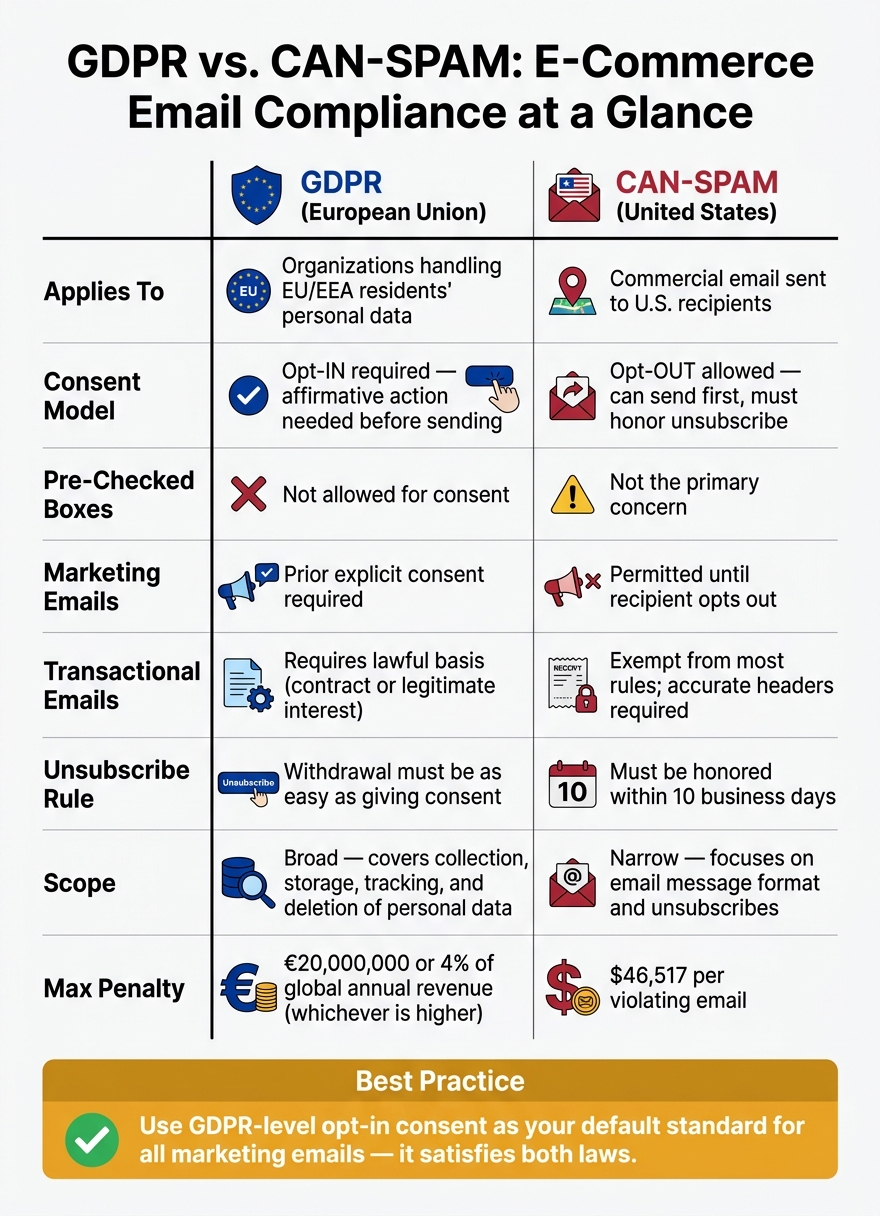
GDPR vs. CAN-SPAM: E-Commerce Email Compliance at a Glance
Email Compliance Made Simple: CAN-SPAM, GDPR, and What Every Marketer Needs to Know
GDPR vs. CAN-SPAM: Key legal differences
Use this comparison to keep consent rules separate from message rules. The table below lays out the main differences.
| Feature | GDPR (European Union) | CAN-SPAM (United States) |
|---|---|---|
| Jurisdiction | Applies to organizations processing EU/EEA residents’ data, wherever based | Applies to commercial email sent to U.S. recipients |
| Consent Model | Explicit opt-in; affirmative action required | Opt-out; no prior consent required before sending |
| Marketing Emails | Prior consent required; no pre-checked boxes | Permitted until the recipient opts out |
| Transactional Emails | Requires a lawful basis, such as contract or legitimate interest | Exempt from most rules; must use accurate headers and sender details |
| Unsubscribe Rules | Withdrawing consent must be as easy as giving it | Opt-out requests must be honored within 10 business days [1] |
| Maximum Penalties | €20,000,000 or 4% of global annual revenue [1] | $46,517 per violating email [1] |
Consent: opt-in under GDPR vs. opt-out under CAN-SPAM
GDPR requires a clear affirmative action before you send marketing emails to an EU resident. In plain English, the person has to actively say yes. That means a checkbox they click themselves, not one that’s checked by default.
CAN-SPAM works the other way. You can send a commercial email to a U.S. recipient without prior consent, as long as the message follows the required formatting rules and includes a working unsubscribe mechanism.
Here’s the simple split:
- EU marketing needs documented opt-in
- U.S. marketing needs a functional unsubscribe link
Scope: data protection law vs. email marketing law
GDPR is not just an email law. It governs how you collect, store, track, and delete personal data, including email addresses. That makes it much broader than many e-commerce teams expect at first.
CAN-SPAM is narrower. It deals mostly with how commercial email is presented and how people can stop getting it.
Put another way, GDPR covers collection, storage, tracking, and deletion. CAN-SPAM focuses mainly on message content and unsubscribes.
Enforcement and financial risk
The penalty models are very different. GDPR penalties can scale with global revenue, while CAN-SPAM can fine each non-compliant email. [1]
That changes how teams think about receipts, shipping updates, and promotional sends. A message that blends transactional and marketing content can create problems fast if it’s classified the wrong way.
How GDPR and CAN-SPAM apply to different e-commerce email types
Email rules change based on why you’re sending the message: transactional, promotional, or a mix of both. The simplest way to sort an email is by its purpose.
| Email Category | GDPR Legal Basis | GDPR Consent Required? | CAN-SPAM Classification |
|---|---|---|---|
| Order Confirmation | Contract / Legitimate Interest | No | Transactional/Relationship |
| Shipping Update | Contract / Legitimate Interest | No | Transactional/Relationship |
| Password Reset | Contract / Legitimate Interest | No | Transactional/Relationship |
| Cart Reminders | Consent / Legitimate Interest | Yes (usually) | Commercial |
| Review Requests | Consent / Legitimate Interest | Yes (usually) | Commercial |
| Loyalty/Promotions | Consent | Yes | Commercial |
| Mixed-Content | Consent (for the promotional portion) | Yes | Commercial (if primary purpose is promotional) |
Transactional emails: receipts, shipping updates, and password resets
These emails help complete or support a purchase. Under GDPR, they usually rely on contract or legitimate interest as the lawful basis.[1] Under CAN-SPAM, they count as transactional or relationship messages, which means they don’t have to follow most of the rules for commercial email. Even so, the headers still need to be accurate.[1]
Marketing emails: newsletters, discounts, and product promotions
For EU residents, GDPR requires explicit opt-in consent before you send newsletters or discount campaigns. That means no pre-checked boxes and no assuming consent just because someone bought from you before.[1]
For U.S. recipients, CAN-SPAM says marketing emails must include:
- Accurate headers
- An honest subject line
- A valid physical postal address
- A working unsubscribe link[1]
This is where things start to get tricky, especially when one email tries to handle both marketing and customer service at the same time.
Mixed-content emails: when a receipt includes a promotion
This is the gray area that trips people up. A receipt with a coupon tacked on might look harmless, but from a compliance angle, it can change the whole picture.
Under GDPR, the purpose limitation principle matters.[1] If a customer gave you their email address to finish a purchase, then using that same address to send promo content goes beyond the original reason for collecting it. In most cases, that promotional piece needs separate consent.[1]
Under CAN-SPAM, the key test is primary purpose. If the marketing part outweighs the transactional part, the email is treated as commercial and has to meet the full set of commercial email rules.[1]
Compliance steps for small and mid-sized e-commerce teams
Rules on paper don’t do much if your email workflows don’t back them up.
Build compliant sign-up forms and consent records
Once you know which emails are transactional and which are promotional, set up separate sign-up and storage workflows for each.
Email compliance starts at sign-up. If you sell to EU customers, GDPR requires clear, affirmative consent. That means pre-checked boxes or implied consent won’t cut it for marketing emails. A double opt-in flow gives you stronger proof of consent for EU marketing lists.
You should also record the date, time, source page, and exact consent text. That way, you can show how consent was collected if you ever need to. If you have older lists with missing consent records, reconfirm consent before sending marketing emails to those contacts.
Keep promotional campaigns separate from transactional emails
After that, keep those email types separate in practice so one list or template doesn’t trip the wrong rule set.
Treat transactional and marketing emails as separate systems. Use different templates, different sending logic, and separate approval steps. This makes it easier to avoid unsubscribe issues and classification mistakes. If a customer opts out of marketing, they should still get order confirmations and shipping updates. Keep CAN-SPAM requirements in your promotional template checklist.
Align compliance with data measurement and retention practices
Once your send rules are set, line up your metrics and retention policy with that same standard.
Collect only the data you need, and measure performance with clicks, conversions, and replies. Use metrics that don’t rely on intrusive tracking. Apply that same discipline to retention and reporting that you use for email classification. Keep an up-to-date list of opt-outs, provide short privacy notices that explain users’ rights to access, correct, or delete their data, and use lightweight verification steps to handle those requests efficiently.
Conclusion: A clear standard for GDPR and CAN-SPAM compliance
GDPR and CAN-SPAM do different jobs. GDPR covers personal data and calls for opt-in consent for marketing, while CAN-SPAM covers commercial email and works on an opt-out model. For e-commerce teams sending to people in more than one region, that split can get messy fast.
The simplest way to handle it is to run with one rulebook across all marketing sends. Since both laws can lead to serious financial penalties, it makes sense to build your process around the stricter bar.
In practice, that means using GDPR-level consent for all marketing lists, even when CAN-SPAM would allow more flexibility. It also means using accurate sender details and adding a valid physical postal address in CAN-SPAM-covered emails.[1]
For e-commerce teams, compliance is much easier when it’s built into the process from day one. List growth, email design, and consent tracking should all follow the same standard. Keep one rule for promotions, another for transactional email, and maintain clean records for each contact. Treat GDPR’s opt-in model as your baseline, separate promotional and transactional sends, and keep consent records up to date.
FAQs
Do I need to follow both GDPR and CAN-SPAM?
It depends on your business and where your audience lives. CAN-SPAM covers commercial emails sent to people in the United States. GDPR covers organizations that process the personal data of people living in the European Union.
If your marketing reaches both U.S. and EU residents, you need to follow both.
Can I add a coupon to an order confirmation?
Yes. You can include a coupon in an order confirmation email as long as the message is still mainly transactional.
Under GDPR, order confirmation emails are usually exempt from standard marketing unsubscribe rules. But there’s a line to watch: if more than 20% of the email is promotional content – for example, a marketing coupon – you need to include a GDPR-compliant unsubscribe option.
What records should I keep for email consent?
Keep detailed records of user consent and opt-out requests for at least six years after the last interaction.
Your records should include the date and time, the method used, the scope of consent, any confirmation sent, and logs tied to data collection, retention decisions, and responses to data subject requests.
An automated, searchable system makes this much easier. It gives you a clear audit trail, which can save a lot of headaches during regulatory reviews.